
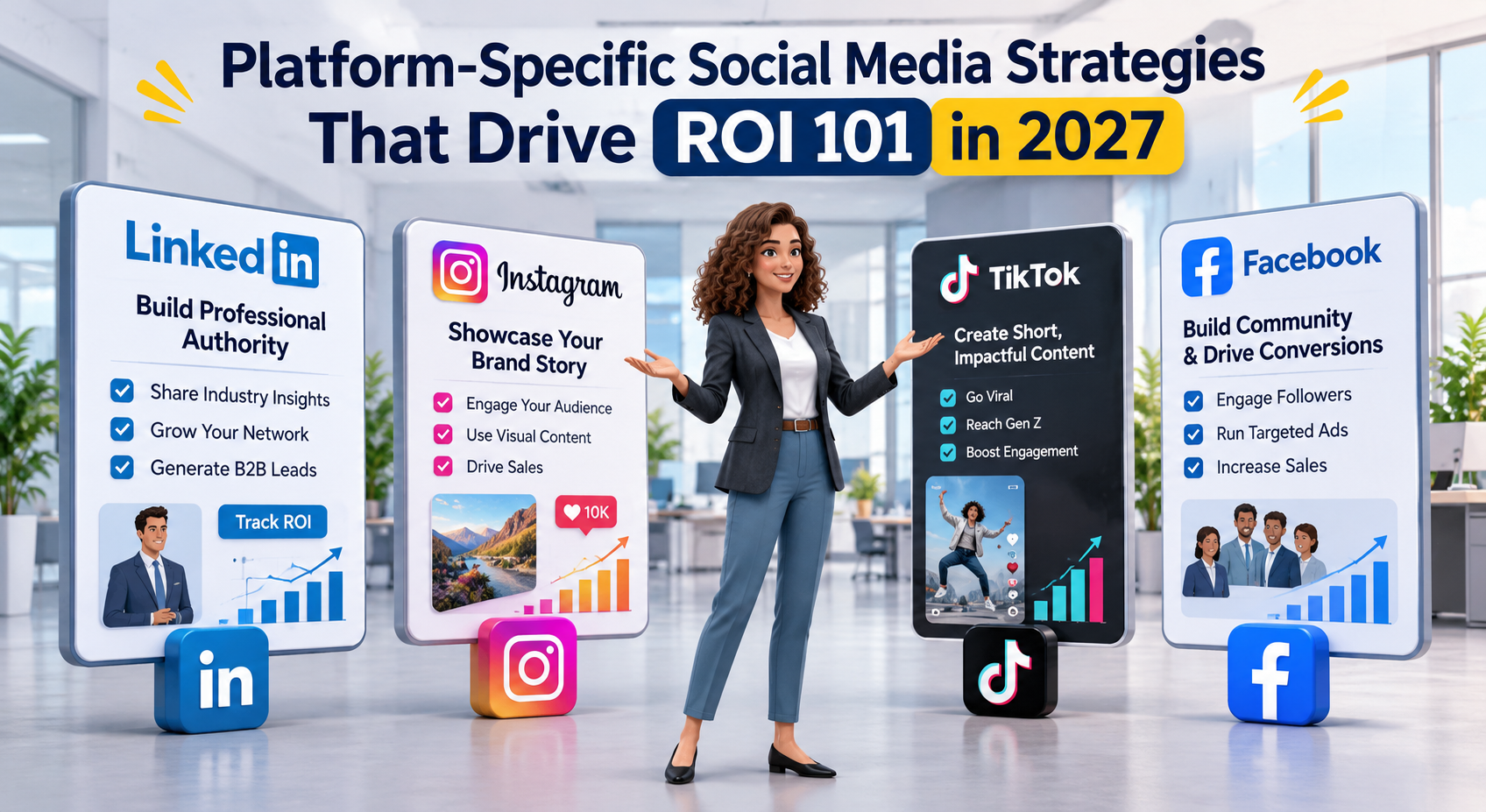
Platform-Specific Social Media Strategies That Drive ROI 101 in 2027

What Are Platform-Specific Social Media Strategies and How Do They Work?
A platform-specific social media strategy gives each network its own goal, format, tone, and posting rhythm, so a business stops repeating one message everywhere and speaks the way each audience expects.
A short-form video that thrives on one network can flop on another, and that gap is the whole reason the approach exists. SEMrush findings reported by the University of Florida’s online master’s program say customized content beats identical cross-posting on engagement. HubSpot adds that 80% of marketers prioritize visual content, which only helps if the visuals suit the network showing them.
In practice, I treat every account as a small job with one outcome. One network might carry customer acquisition, another brand awareness, and Hootsuite’s guide frames its own platform roles in much the same way. The sections below follow the order I would work through with a client: pick the networks, learn their habits, set targets, then schedule, produce, and refine.
Which Social Media Platforms Should Your Business Actually Use?
Your business should use only the few platforms where its audience already spends time and where each account can do one clear job, rather than every network available.
Roughly 4.88 billion people use social media, according to DataReportal figures quoted by RingCentral, which explains the pull toward being everywhere. RingCentral points to brands like Skittles and Dollar Shave Club as strong promoters, yet their reach says little about what your budget can sustain. RingCentral also treats social as one piece of an omnichannel experience instead of a stand-alone effort.
Size alone is a poor guide. 69% of US adults use Facebook, per Pew data cited there, and Facebook sends more web referrals than other networks, while its groups support community-building. Instagram counts over 1 billion monthly users, but only 22% of American adults use Twitter, so reach and fit are different questions. Some networks also lend themselves to influencer collaborations; others simply do not.
Hootsuite recommends checking the purpose of each account and asking whether an outdated account deserves a redirect or retirement. A rival that dominates Facebook but ignores Instagram leaves an underserved network that may reward you faster.
How Do Instagram, TikTok, LinkedIn and Other Platforms Differ?
Each platform differs in audience, content culture and technical rules, so one message needs a different shape on Instagram, TikTok, LinkedIn, Facebook, Twitter (now X) and Pinterest.
| Platform | Typical audience | Content that suits it |
|---|---|---|
| Broad, diverse adults | Short text posts, uploaded video | |
| Younger crowds | Images and brief clips | |
| Twitter (now X) | People following live chatter | Threads and replies |
| Inspiration seekers | Boards and repins | |
| TikTok | Teenagers and young adults | Trend-driven clips |
| Professionals | Industry articles, job listings |
Platform-specific features shape how people respond. Twitter’s 280-character thread format, Pinterest’s Pin It buttons, and TikTok’s Duet and Stitch options all change behavior, while the FYP hashtag nudges TikTok’s feed. Algorithm updates keep shifting visibility, so a format that worked last quarter deserves a recheck.
Hootsuite’s example roles show the logic: Instagram builds brand affinity with existing customers and LinkedIn helps attract new talent, while another network is reserved for reaching younger consumers. RingCentral adds a warning on tone: almost 40% of followers may leave over misused slang, and pandering reads as worse than being plain.
Before copying anyone, a competitive analysis shows what each network rewards. Oreo is RingCentral’s example of Twitter done well; Digital Marketing Institute notes WhatsApp sits among its top four by an active user index, and Reddit trades in niche memes. Twitter also demands a faster posting schedule than LinkedIn, and I schedule against optimal times rather than my own working hours.
How Do You Set Goals and Metrics for Each Platform?
Set goals for each platform that are specific, measurable, attainable, relevant, and time-bound, then track metrics tied to business results instead of likes.
Hootsuite says you cannot judge social ROI without goals, and it suggests one-sentence mission statements per network so every target keeps a job. Success should be judged by conversions and similar outcomes, since likes and retweets are hard to prove valuable. UF also advises watching click-through rates, and brands that reply to comments report higher customer loyalty.
A concrete case: Jugnoo, an auto-rickshaw service in India, used Facebook Analytics to learn that 90 percent of referring users were aged 18 to 34 and 65 percent of that group used Android. Targeting them produced a 40 percent lower cost per referral. I like this example because the insight came from reading data, not from a bigger spend.
Pair each goal with tooling that keeps numbers comparable. RingCentral names HootSuite, CoSchedule, and Zapier as options for steady posting.
How Do You Research Your Audience and Competitors on Each Network?
Research your audience by studying who uses each network and how, then study what competitors do well and badly so you can find gaps worth filling.
Audience preferences show up in demographics. RingCentral, citing Sprout Social, puts about 75% of women and 63% of men on Facebook, strongest across 18–64, while Instagram is popular with millennials. The same source says 41% of teenagers rated Snapchat their most important network, and 85% of Facebook video watchers prefer no sound.
UF notes LinkedIn favors thought leadership and Twitter remains a hub of real-time conversations. Digital Marketing Institute lists YouTube among the top four networks, though that tells you where people are, not what they want from you.
On rivals, RingCentral calls it scoping out the competition: note what works, what doesn’t, and what they miss, then build a competitive edge from the gaps. Hootsuite also suggests asking followers, your email list, and website visitors through surveys what they want to see more of, and keeping research tied to business objectives. Remember time zones too, since your audience may not wake when you do.
What Should an Account-by-Account Audit Check?
An account-by-account audit should check what is working, who is connecting with you, whether your target market uses the network, and how you compare with competitors.
Hootsuite’s three questions for each account work well as a sequence:
- Audience: Is my audience here?
- Behavior: How are they using this platform?
- Goals: Can this account help achieve meaningful business goals?
Pull evidence from analytics tools such as Instagram Insights, and read engagement rates instead of leaning on vanity metrics. Hootsuite suggests LinkedIn as the place to engage existing employees, and an audit may show that a network such as WeChat matters little to you. LinkedIn also rewards industry discussions, so check whether your account joins them.
Use audit data to build audience personas and write at least three goals. UF’s article ties a consistent voice to 33% higher brand recall, so check that profiles match. Add UTM parameters to links, treat the plan as a living document, and let automation handle routine posting while a person answers direct messages. Ignore trolls; RingCentral says toxic negativity has no fix.
How Should You Schedule Posts Across Platforms?
Schedule posts with a calendar that lists the date, time, and content type for every channel, so each network gets a deliberate slot.
Because attention spans are shrinking, give each calendar slot one idea and keep messaging tight. Hootsuite warns against trying to stretch yourself thin, and I find a dedicated social media team or a single owner makes the calendar real. Tie slots to goals such as 50 new followers per week or leads generated, and weigh paid advertising against organic effort; Instagram alone has 1 million advertisers.
Plan formats into the calendar. Live streaming sessions, carousel posts and infographics each deserve their own slots, and UF reports video posts draw 48% more views than static content. Facebook videos need closed captioning, copy near 111 characters, and Instagram permits up to 30 hashtags.
Pick times from data. Check platform algorithms and peak engagement times, run constant testing, and use social listening with industry keywords to spot topics. Fold in user-generated content, testimonials, and contests so the calendar is not only your own voice.
Which Content Formats Work Best on Each Platform?
Content formats work best when they match how people use each network: visual boards on Pinterest, trend-driven clips on TikTok, professional articles on LinkedIn, and video help material on a video network.
Pinterest, with about 322 million users, rewards visually appealing boards that people save for inspiration. TikTok has around 100 million US users, centered on Gen Z, and leans on trending audio, while Instagram suits brand storytelling. Facebook’s interactive features invite replies. That video network suits help content, per Hootsuite, and Twitter is where Hootsuite engages industry influencers.
Mix matters as much as format. Hootsuite’s example content mix splits posts like this:
| Content type | Share |
|---|---|
| Drives traffic to your blog | 50 percent |
| Curated from other sources | 25 percent |
| Supports enterprise goals | 20 percent |
| About employees and company culture | 5 percent |
If you are unsure where to start, Hootsuite’s 80-20 rule puts 80 percent on informing, educating or entertaining and the rest on promotion.
Measure the conversion rate of your organic social posts, and cross-promote accounts so followers find you elsewhere. Fill every one of the profile fields and use correctly sized images. Keep color schemes, typography, and branded templates steady, and test emerging formats in small doses.
How Do You Stay Consistent While Engaging Your Community?
Stay consistent by keeping tone, visuals, and values uniform on every network while replying to each community in the style of its own platform.
Uniform tone reinforces brand identity, and a cohesive content calendar with a steady hashtag habit supports brand loyalty. Consistency is not redundancy: UF says content should adapt to each network while the core message holds.
RingCentral treats public conversations as part of the customer experience and customer service, with an answer expected within a day. A social media management platform such as RingCentral Engage Digital consolidates messages, which makes customer feedback easier to act on.
Protect the brand too. Report impostor accounts, get your accounts verified, and revoke access and change passwords when staff leaves; RingCentral cites Deciem as the cautionary tale.
For engagement, interactive polls, behind-the-scenes videos, viral challenges and trending hashtags, plus room for spontaneous engagement, help a brand stay top-of-mind.
How Often Should You Test and Adjust Your Platform Strategy?
Review your platform strategy regularly using data from each network, test variations against one another, and update the plan whenever results or platform conditions change.
Hootsuite’s approach reduces to a loop:
- Review results in each network’s analytics.
- Compare them with your goals.
- Test one change at a time.
- Ask followers what they want.
- Update the plan and tell the team.
Revisit SMART goals with realistic milestones to keep executive buy-in, and rerun a social media audit when results stall. A strategic redirection of one account beats abandoning the whole strategic approach. Watch competitors’ strategic shifts, and remember that brands customizing content per network see a 23% engagement increase per the figure UF’s article cites.
Keep audience demographics and content trends in view, and favor fewer channels over thin coverage. Bulk scheduling against firm deadlines frees time for creative work. Test shareability and retention rates, and try geotagging: only 5% of posts carry a location tag, yet those can earn 79% more engagement per AdWeek.