
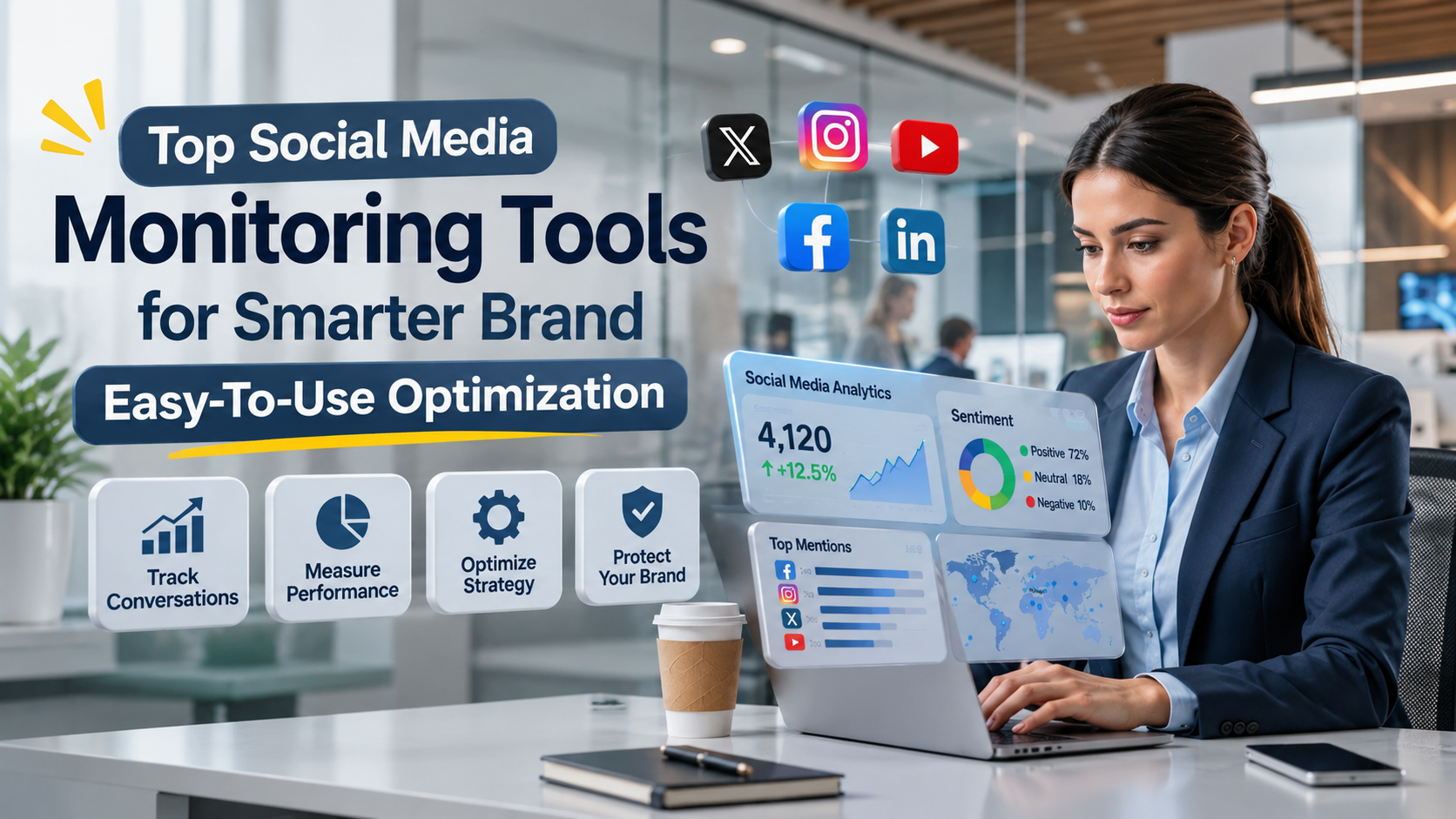
Top Social Media Monitoring Tools for Smarter Brand Easy-To-Use Optimization

What Are the Best Social Media Monitoring Tools?
The best social media monitoring tool is the one whose platform coverage, alert speed, and price fit how your team works, and Hootsuite’s 2026 roundup of 12 tools sorts its picks along those same lines. It lists Perch by Hootsuite from $99/user/month, Mention for lean communications teams, and Lumen by Talkwalker for enterprise social and communications teams.
Every roundup carries a bias, including that one, because Brand24 and Hootsuite each sell their own products next to rival tools. Treat any ranking as a shortlist rather than a verdict, and check pricing transparency first, since some vendors list rates openly while others route buyers through custom pricing or an enterprise tier. A free trial on one shared topic is the fairest comparison I know, because the gaps between tools show up fast.
Features then separate the field. Tools earn their cost through crisis prevention, quicker customer service, and social media analytics that show which posts landed. Sentiment analysis accuracy decides whether positive and negative labels deserve trust, image recognition catches logos in photos with no caption, and predictive analysis, which Talkwalker offers, forecasts where a topic is heading.
What Does Social Media Monitoring Actually Mean?
Social media monitoring is the practice of tracking what people say about a brand, its products, its rivals, or its industry across social platforms. The audience is enormous: more than 5 billion people use social media, according to Statista data cited by HubSpot, and 50.4% of users research brands online before buying, per Meltwater’s Global Digital Report.
Monitoring differs from listening in depth. Hootsuite frames monitoring as short-term tracking that answers what is being said right now, while listening analyzes what the data means and what to do next. I think of monitoring as the always-on alarm and listening as the monthly review, because tone and sarcasm belong to the second job. BrandMentions, for instance, sorts sentiment into 12+ emotions instead of a bare positive-or-negative label.
Investigation tools stretch the term further. ShadowDragon says platforms built for law enforcement go beyond brand tracking, using OSINT methods and alias tracking to link accounts, whereas brand tools simply watch mentions. At the lightest end, Google Alerts offers a free baseline, but another vendor guide warns that free options quickly become too limited as a business grows. Whatever the tool, the aim is early detection: spotting a shift in the conversations about you before customers do.
Why Would a Brand Pay for Monitoring at All?
Brands pay for monitoring because it turns scattered posts into reputation management, sales leads, and early answers before a small complaint becomes a PR crisis. Hootsuite groups the payoff into four areas: stopping a crisis early, answering customers, building a following, and tracking performance.
Sentiment is the clearest signal. A sentiment drop after a product launch tells a marketer something is wrong before sales figures do, and a PR team can respond with facts while the story is still small. Salesforce advises sending criticism to PR and praise to marketing, which keeps escalation from stalling in one inbox.
Monitoring also feeds sales and strategy. Awario’s Leads module surfaces people complaining about rival products or asking for recommendations, a use Brand24’s reviewer called sales intelligence rather than plain monitoring. A marketing-studio founder quoted by Hootsuite links monitoring to spotting crises and influencer partnerships, and Salesforce’s feature list names influencer identification and competitor benchmarking. Watching patterns over months shows which content excites people, so social media intelligence supports long-term choices as well as quick replies and a steadier brand reputation.
How Do You Choose a Monitoring Tool That Fits Your Team?
Choosing a monitoring tool comes down to matching its reach and speed to how your team works, and Hootsuite lists six checks to run before shortlisting. Because the checks are parallel, a short list helps:
- Reach: how many networks, forums, blogs, news sites, and review sites the tool watches. Pew data cited by Hootsuite says half of U.S. adults use Instagram and 37% use TikTok, so gaps matter.
- Speed: how quickly new mentions reach an inbox, since minutes matter more than features in a crisis.
- Label quality: whether sentiment goes beyond positive, negative, and neutral.
- Connections: whether the tool plugs into the rest of your stack.
- Price clarity: listed rates versus quotes, and what a base tier includes versus an add-on.
- Room to grow: support for more brands, regions, languages, and team members.
Match those checks to practical inputs. Track a brand name, tagline, and product names at minimum, then a few industry keywords. Keyhole’s entry tier covers only 3 keywords, which shows how quickly limits bite. Brand24 says its alerts work as an early warning system on niche forums, and Hootsuite urges alerts for unusual activity.
Specialized needs add filters. ShadowDragon’s platform draws on 500+ data sources, Media Sonar offers location-based filters, and buyers in regulated settings look for CCPA and GDPR compliance. Agorapulse’s automated white-labeled PDF reports save client-facing teams reporting time, and industry benchmarking, such as Brand24’s Iconosquare example of 2.3% engagement against a 4.1% niche average, shows where an account stands.
Which Monitoring Tools Do Reviewers Actually Compare?
The tools reviewers compare most are Brand24, Perch by Hootsuite, Sprout Social, Agorapulse, Mention, and Lumen by Talkwalker, and each roundup slices them differently. Hootsuite’s table gives a quick view of who each suits and what trial each offers:
| Tool | Best for | Trial |
|---|---|---|
| Perch by Hootsuite | Monitoring, posting, and reporting together | Yes |
| Lumen by Talkwalker | Enterprise social and comms teams | Demo |
| Brand24 | Scoring the reach and importance of each mention | 14 days |
| Brandwatch | Large teams with bigger budgets | No |
| Mention | Lean PR, comms, and social teams | Yes |
| Sprout Social | Larger social teams with bigger budgets | 30 days |
| Agorapulse | Brands with heavy social ad comment volume | 30 days |
| Mentionlytics | Multilingual and global brands | 14 days |
User feedback adds a harsher layer. Brand24’s roundup draws on G2 reviews and Trustpilot complaints, noting that Hootsuite scores 1.5/5 on Trustpilot across 554 reviews, mostly over billing complaints, while Sprout Social scores 2.0/5 from 79 reviews. On G2 the same article rates BrandMentions 4.8/5 and Agorapulse 4.5/5. Both rankings come from vendors with products in the field, so weigh them accordingly.
Capabilities differ more than prices suggest. Brandwatch offers 48 Boolean operators and a year of history across 100 million sources, Mentionlytics stresses multi-language support, and Digimind covers 82 languages. Talkwalker’s free tools are disputed: HubSpot says the standalone Talkwalker Alerts and search tool are gone, yet Talkwalker’s own page still offers them, with 7 days of historical data on search against up to 5 years in the full product. Hootsuite also lists a demographic-focused tool with a free plan, plus ReviewTrackers, which pulls TripAdvisor and Google reviews into one Perch stream. The specialist end appears below, such as ShadowDragon’s Horizon, while another roundup adds Sendible, built for teams running many client profiles. Salesforce notes that monitoring can help teams capture leads from people who discuss a brand without following it.
Can You Monitor Social Media for Free?
Free social media monitoring now means short trials and a few small trackers rather than full products, because HubSpot found that most once-free tools have shut down or hidden their best features. HubSpot’s writer tested seven tools, and the table shows what four of them offer:
| Tool | Trial | Paid from |
|---|---|---|
| BrandMentions | 7 days, plus free ad hoc trackers | $79/month |
| BuzzSumo | 7 days | $199–$999/month |
| SmarterQueue | 14 days | $24.99/month |
| Talkwalker by Hootsuite | 30 days | $99/month |
Trial mechanics deserve a read. SmarterQueue starts its 14-day countdown only once a user finishes setup and begins scheduling a first post, which buys more time than the number suggests, and Mentionlytics gives full access with no card. Elsewhere, an annual contract with auto-renewal can turn a trial into a bill; Hootsuite lists Brand24’s $199 rate as billed annually, against $249 paid monthly. Even good free trackers have limits: BrandMentions’ reports are pulled in under a minute, yet HubSpot cautions that few tools deliver every mention through a real-time feed.
Capabilities matter during a trial. Perch’s Quick Search lets anyone look up hashtags, brands, and events worldwide, Mentionlytics links to Hootsuite so mentions can be assigned from one dashboard, and Salesforce lists campaign effectiveness among monitoring’s core uses. Teams managing multiple accounts should check those integrations before committing.
Do Law Enforcement Agencies Use the Same Tools?
Law enforcement agencies mostly use specialized investigation platforms rather than brand-monitoring software, although the two categories share alerts and dashboards. ShadowDragon’s roundup of eight tools includes Kaseware for case management, Media Sonar for geo-targeted collection, Dataminr First Alert for AI-based event alerts, AlertMedia for emergency messaging, Digital Stakeout for public-sentiment mapping, Voyager Labs for behavior analysis, and Everbridge for two-way public communication.
The practical overlap is alerts and live views. Kaseware generates reporting dashboards for command staff, and Digital Stakeout lets investigators tailor alerts to key terms, locations, or risk levels, much as brand teams set sentiment triggers. A mention spike around a venue can be the first signal, while negative spikes in public sentiment after an incident show how a community is reacting; Everbridge adds anonymous tipping for that same community. Dataminr’s alerts support proactive preparation, and situational awareness during major events supports emergency planning.
Automation has limits. ShadowDragon stresses that misinformation can go viral quickly, and that false profiles or edited posts can produce wrong conclusions, so corroboration and human judgment remain essential. Forrester, cited by Hootsuite, predicts a third of companies will erode trust in 2026 by deploying customer-facing AI without adequate human judgment.
How Much Do Social Media Monitoring Tools Cost?
Social media monitoring tools cost anywhere from nothing to several hundred dollars per month, and Hootsuite puts entry-level paid tiers at roughly $69 to $199 per month, with enterprise listening quoted by data volume and seats. The low end is genuinely cheap: Metricool starts at $18 and Tailwind at $14.99 per month according to HubSpot, Fedica has a free tier in Hootsuite’s list, and Nextiva advertises its broader platform from $15 per month. Nextiva’s list also calls Zoho Social budget-friendly.
Real costs rise once seats and extras arrive. Brand24’s author drew on Reddit threads and reviews on G2, and reports that Sprout Social’s listening module costs about $999 per month on top of $199 per seat; a three-person Professional tier runs about $10,764 per year, or about $22,764 with listening. Hootsuite’s full Talkwalker-powered listening sits behind its own paywall, starting near $15,000 per year on Enterprise.
Value depends on inclusions. Agorapulse’s listening module costs $40 per month versus about $999 at Sprout Social, and its unified inbox and GA4 integration, which shows which posts drove conversions, help justify $79 per user. Sprout Social’s Smart Inbox earns praise for heavy message volume, Hootsuite’s strength is publishing, and BrandMentions’ Starter tier refreshes only daily, with hourly updates from $299 and real-time from $499.
How Often Should You Check Your Monitoring Tool?
Businesses should review their monitoring tool every day, according to Nextiva, because fast replies protect customer relationships and reveal shifts in audience mood. Nextiva adds that mentions and feedback show up from the first day, though spotting meaningful movement takes weeks of collected data.
Habits keep each check short. Hootsuite suggests tracking a brand name, competitors, and branded tags at minimum, and Keyhole’s hashtag feed shows posts beyond raw numbers. Talkwalker’s Free Social Search and BrandMentions’ hashtag tracker help small teams notice a trending hashtag before it reaches the news. Salesforce suggests using monitoring for triage, routing each mention to the right team, which can reveal brand advocates.
Limits shape how often checking is worthwhile. BrandMentions’ Starter tier carries a 5-keyword limit and a 5,000-per-month mention cap, according to Brand24, so heavy brands may exhaust it quickly. Watching direct mentions alongside broader trends supports customer satisfaction, which Salesforce lists as a customer-service benefit.
Is a Specialist Monitoring Tool Better Than a Management Suite?
A specialist monitoring product serves teams better when tracking mentions is the main job, while a management suite fits better when posting and replying come first. Brand24’s FAQ says management suites such as Hootsuite, Sprout Social, and Agorapulse treat monitoring as a side feature, often locked behind costly extras, whereas specialists such as Brand24, BrandMentions, or Talkwalker offer more analytical depth.
Suites also carry price baggage. Sprout Social’s per-seat pricing multiplies with every added user, and its entry plan gets pricier once listening is added; Keyhole’s data caps can pause silently mid-campaign, according to Brand24. For scalability, check whether seats, brands, and regions can grow without repricing, and note that another roundup lists workflow management among advanced features for teams overseeing many brands. Hootsuite’s expert links responsive monitoring to deeper loyalty, and Talkwalker’s logo detection finds brands in photos and video frames where no text mentions them.
At the far specialist end, investigation platforms add threat detection, identity resolution, and chain of custody records that help evidence hold up in court, while Voyager Labs automates review of social media warrant returns. ShadowDragon also stresses privacy-law compliance and safeguarding civil liberties.
Can Monitoring Help When a Crisis Hits?
Yes, social media monitoring helps during a crisis by alerting teams to spikes in negative talk early enough to respond, as Nextiva’s guide explains. Hootsuite makes the same point, calling alerts critical because a crisis can arise at any time.
A written response plan matters as much as the alerts. Salesforce says a majority of social media crises can be avoided with preparation and investment, and Talkwalker argues that proactive communication built on audience sentiment beats reactive apologies after a story spreads. Checking branded hashtags and brand names should become a routine, since Nextiva says collecting enough data to see meaningful shifts takes several weeks.
Where the system lives matters less than its handoffs. Whether a team uses a dedicated tool or an all-in-one suite, crisis alerts are often a secondary feature, so confirm CRM integration and a support ticket route that sends complaints to service staff, as Salesforce describes.