

Transform Once, Publish Everywhere: Build Your Brand Fanbase

What Are Practical Content Repurposing Ideas?
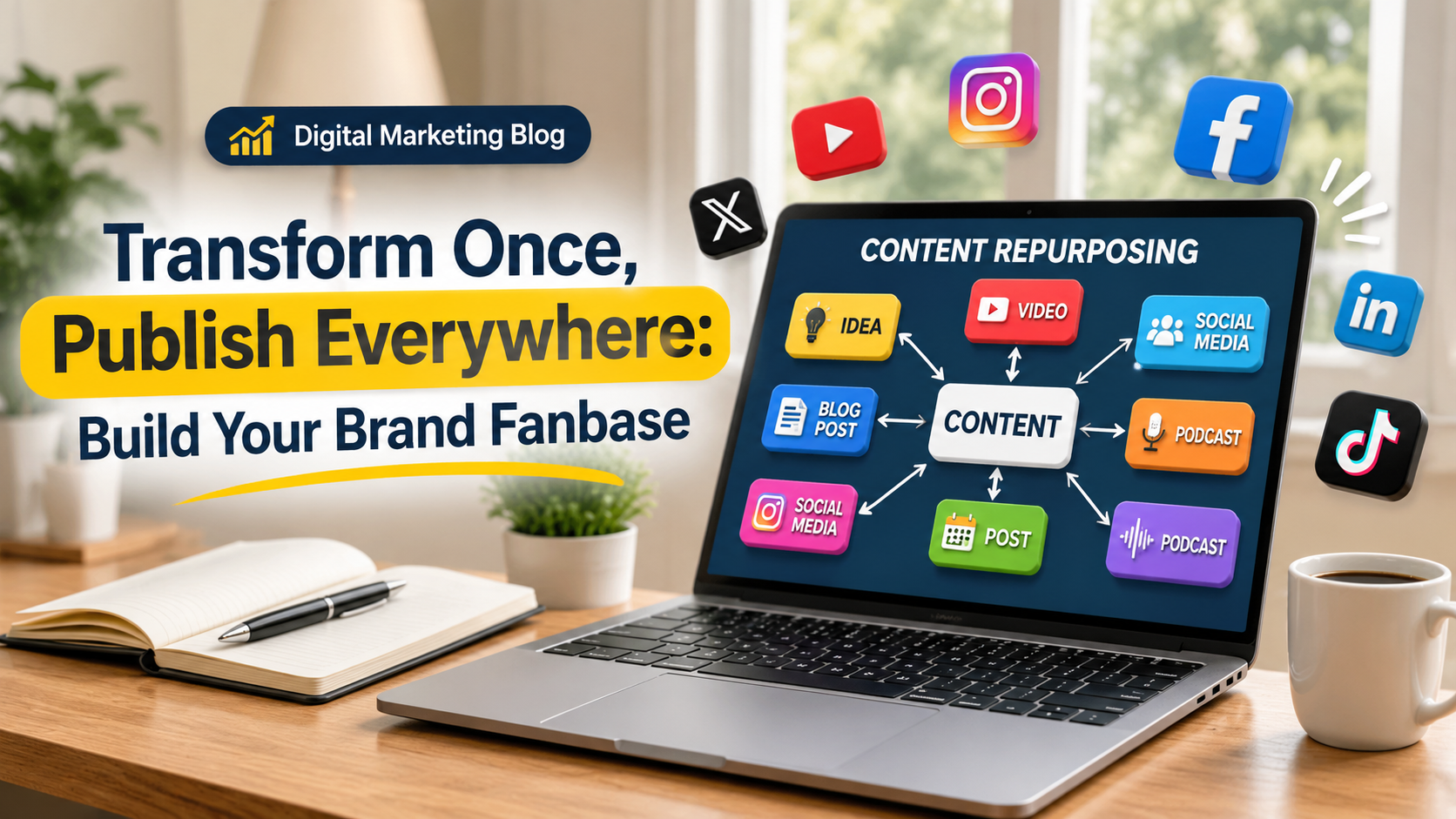
Content repurposing ideas turn one finished piece of content into several new pieces in different formats and on different channels, such as cutting a blog post into social posts, a video, emails, and an ebook.
Treat recycling as a design problem, not a copy-and-paste job. Posting something as-is simply repeats it, while repurposing reshapes the idea so it can reach people who never saw the original, in multiple formats. One Substack creator’s 1 = 15 rule makes the scale concrete: a single idea becomes 1 carousel, 1 infographic, 1 newsletter, 1 blog post, 1 long-form video, 5 short-form videos and 5 written posts, which adds up to 15 assets.
The strongest raw material is your highest-performing work: a long guide, a webinar, or a report whose chapters each carry a separate idea. Buffer suggests at least five smaller posts from every long-form piece, and one master content piece can even anchor an extended campaign. From there, the rest of this guide walks through the formats, and the judgment calls that decide which idea fits which channel.
Why Repurpose Content Instead of Creating Something New?
Repurposing content saves the time of starting from scratch while extending the reach and search visibility of work that already exists.
Marketers keep coming back to it because the crux of the idea has already been researched, written, and approved. Buffer lists three payoffs: wider reach through new audiences, more content without burning out, and a better SEO footing because several pieces target similar keywords. Cvent’s own team turned a sustainability session at its annual trade show into a long-form blog post packed with tips and quotes.
The raw material can be larger than a blog post. A State of Influencer Marketing report, for instance, can be shrunk into an article of its own, which shows how research reports keep feeding fresh blog content. Buffer likewise turned its post on content pillars into an Instagram carousel and a thread on X.
Direction matters too. The extended process starts with one core idea and builds new pieces around it, rather than cutting a long podcast down afterwards. Customer feedback gathered at events can become written or video testimonials, and a handful of key channels is enough to carry all of it.
How Does Repurposing Differ From Crossposting and Reposting?
Repurposing adapts the core idea of a piece into a new format for another channel, while crossposting shares it unchanged on another platform and reposting republishes it on the same platform.
| Method | Definition | Primary benefit |
|---|---|---|
| Crossposting | Sharing a piece of content as-is on a different platform | Saves time |
| Reposting | Publishing the same piece again on the same platform | Doubles down on success |
| Repurposing | Adapting the core idea into a new format, such as blog to video | Improves distribution and reach |
Repurposing means building new formats around the idea, and that is why it takes more effort than the other two. Repetition is not the enemy either: a marketing consultant who has reshared the same social posts across 10 years reports that familiar stories build connection rather than boredom, which is a personal observation worth testing on your own audience.
Copying everything everywhere can feel repetitive, and Buffer’s advice is to ace two to three channels rather than manage five platforms poorly.
When Is the Right Time to Start Repurposing Content?
The right time to start repurposing content is whenever a piece exists that you want more people to see, and ideally at the planning stage before anything is published.
Chima Mmeje, Senior Content Marketing Manager at Moz, starts thinking about repurposing the moment a content brief lands on her desk, weighing metrics, audiences, and where they spend time online. Pierre Herubel works the same way, mapping where each idea will go before creating anything, which he credits for his weekly output. Both treat new posts as repurposing candidates from day one rather than a later cleanup.
Forgetting makes timing urgent. According to the Ebbinghaus Forgetting Curve, cited by Cvent, people forget information within days or even hours of hearing it. Format evidence helps too: Designrr cites Edison Research showing 74% of podcast users listen to learn something new, and Music Oomph reports that 51% of the population has listened to a podcast.
When you enter a brand-new platform, begin with cross-posting or light repurposing, then add native material as the audience builds.
Which Content Should You Repurpose First?
Start with the content that has already proven itself, then work backwards through the rest of your library.
Audit your existing content and rank it by evidence: popular posts with traffic, engagement, and product clicks come first. If a large backlog is waiting, begin with old posts that still matter, and refresh any that look stale before reusing them.
Your goal changes the order. Reviving declining pieces points to older posts, while widening awareness points to recent ones. Buffer also suggests monitoring the posts with the most reach and scheduling reposting after a set period.
Measure what happens next. Cvent recommends KPIs such as website traffic, engagement rates, conversions, and lead generation, tracked in Google Analytics, with A/B testing for headlines, visuals, and calls to action. A weekly feedback loop of polls, comments, and keywords tells you what your target audience actually asks for.
How Do You Build Repurposing Into Your Workflow?
Build repurposing into the workflow at the planning stage by deciding, before you create anything, where each idea will travel next.
- Pick one hub idea that is a little longer or more in-depth than the rest.
- Map its destinations across video, social, and email before you draft it.
- Collect visuals from your phone gallery and store them in Google Drive folders so they are easy to find.
- Pull transcripts with the Glasp extension when the source is a YouTube video.
One blogger’s post on how business owners can use Zapier spawned spin-off articles for VAs, writers, and solopreneurs, which shows how a single topic stretches when the plan exists first. Systems also protect against burnout: writing from predictable steps beats inventing 40+ pieces of fresh ideas every week.
Ask honest questions about bandwidth. Justin Simon, a Content Distribution Consultant for B2B SaaS, argues that executing fewer things consistently drives more growth than doing everything at once. Keep goals in view, use social listening and keyword analysis to choose topics, respect your marketing budget, and make repurposing a standing task so recent posts do not accumulate in a pile.
Do You Need to Repurpose Content for Every Channel?
No — repurpose only for channels where your audience is active and where you can keep the quality high.
Buffer’s rule is simple: only add a platform when it makes sense for your audience, and you have time to show up. Creator Laura Whaley crossposts across TikTok, Instagram, and YouTube Shorts because those formats are similar. Entering a new channel is different: you can repurpose from X into Threads, but mix in native posts or the feed reads as repetitive.
Adapt to each platform’s style. Consistent messaging builds brand recognition, and focusing on recent posts supports brand awareness. One blogger took a topic on tour through guest posts for different audiences, and a four-email welcome sequence or weekly sends to subscribers can stretch the same article. Spread repurposed pieces strategically, and give event-driven posts their own hashtags.
How Can You Turn Blog Posts Into Social Media Content?
Break the blog post into smaller native posts — an introduction, a subsection, a takeaway, an example or a quote — and reshape each one for the platform.
Buffer’s 5-to-1 rule asks for at least five smaller posts from every long-form piece, and one blogger turns a single post into 10 or 12 posts for Facebook pages, Instagram and X. A static idea can become a caption or a carousel: Buffer converted a blog post about AI prompts into an Instagram carousel, and John Bonini repurposed a newsletter on content strategy into a social post.
Search benefits follow. Repurposing supports SEO by creating several pieces that target similar keywords, and text-friendly networks such as Bluesky make adaptation easy. A common mistake is assuming you need dozens of formats; a post of 1,200 words can supply a week of posts, and its introduction can double as a one-off email.
Video and visuals join the mix. Try a Facebook Live walkthrough, a run of Instagram stories, or short-form clips, much as Cleo Abrams cut an Instagram Reel from a YouTube video. A Pinterest instructographic blends instructions with graphics. Respect platform etiquette: shorter beats longer on social, and each piece belongs on your content calendar.
Can You Turn Written Content Into Video?
Yes — a written post can become a script for a video, a live walkthrough or a short clip, depending on how much production you want.
Treat the written post as the anchor piece and ask what its clear points look like on screen. Buffer notes that not every article distils into a 15- to 60-second TikTok or Instagram Reel, but posts with obvious points often do, and long videos can be cut into YouTube Shorts. A company cut its video podcasts into LinkedIn posts, and a thread on X can come from the same source.
Production can stay light. Filming seven seconds of B-roll at your desk builds a library quickly, and keeping transcripts makes captions easy. YNAB reused the images from a redesign video in an Instagram carousel, while The Know reads headlines as Reels. Tommy Walker turned live editing sessions into podcasts on Spotify and Apple Podcasts.
Doing a mediocre job on five platforms is worse than two done well, and the debate over polish is one I settle simply: a clear idea beats fancy gear.
How Do You Repurpose Content Into Podcasts and Webinars?
Record the material as audio or host a live session around it, choosing sessions that are informative and conducive to the format.
Cvent suggests panel sessions, keynotes, and presentations for webinars, and a popular session on Generation Z was repurposed into both a blog post and a webinar. Different learning styles are served when people can read, watch, or listen to the same idea.
HypeAuditor partnered with Gordon Glenister for a YouTube live webinar on its 2023 State of Influencer Marketing report, and Modash cuts its video podcasts into social posts. The cut process of trimming a long podcast into a short clip can feel awkward, so building around one idea often works better.
Start from a video script if you want, record the audio, and publish on YouTube too, giving each format its own home.
How Can One Blog Post Become an Email Series?
Split the post so its introduction becomes a single email, or turn each subsection into one email in a short series.
- Use the introduction, often a story or general lead-in, as email copy and link out to the rest.
- Expand each subsection into its own email with extra examples and segues.
- Send them on consecutive days to new signups, or weekly across a month.
Brittany Berger points out that blog posts run longer than the best emails, so cutting them up is natural. SparkToro regularly shares snippets of its articles in its newsletter, and Cvent suggests sending key takeaways from each session. A strong hook lifts open rates, and predetermined outlines keep the work fast.
Write consistently, and treat the series as native content for the inbox, not a pasted blog. Over time, the same emails can be bundled into how-to guides.
Can Blog Posts Become Ebooks and Online Courses?
Yes — related posts can be combined into an ebook or reorganized as a short online course.
Giving old posts a second life as an ebook works well once enough material exists, and Designrr lets you import from a URL. Its Dynamic Transcript feature grabs images to illustrate transcribed text. Cvent notes ebooks make useful lead magnets, so choose evergreen, high-value pieces and outline first.
Other publishers use the same logic: Influencer Marketing Hub reshapes its annual report into an article, and Ahrefs embeds a ChatGPT SEO video into a blog article. For layout, reuse background templates and icon sets, establish a visual hierarchy with headings and varied font sizes, and finish with a clear call-to-action.
A daily email series built with MailChimp or Campaign Monitor can extend the life of each chapter, and case studies based on internal data add proof. Protect quality above speed.
How Do You Turn Content Into Infographics and Visual Assets?
Turn data, quotes, and lists into an infographic, instructographic, or carousel, drawing on a reusable library of templates.
Designrr cites a Demand Gen Report finding that infographics can increase web traffic by up to 12%, and a Content Marketing Institute study showing B2B marketers’ usage at 65%. Creators keep a library of visual assets so a graphic takes minutes instead of hours, and Canva makes carousels quick.
Moz repurposed its AI for SEO post into an OG image, and Splainer turned a newsletter about Elon Musk‘s AI chatbot into a carousel. A SlideShare deck is another route if you add a voiceover to slides; audio quality matters.
Marketing by Shelby suggests pasting past pieces into a Google Doc or notes app, noting the next format, and even reformatting for the same platform. Ask permission before using a customer’s name or comment.
How Do You Repurpose Event Content, Case Studies and Testimonials?
Turn recorded sessions and customer interviews into blogs, webinars, videos and written case studies.
Cvent lists 11 ways to stretch event content. Event marketers gain ROI by planning outlines, posting blogs at a regular cadence and mining sessions for key themes, quotes and speakers. Invite speakers back for a follow-up session with a webinar and live Q&A. It’s podcast Great Events shares event stories.
For video, storyboard the flow and keep explainer videos to two minutes or less. Designrr suggests an expert advice ebook from interviews and online workshops.
Questions from customer support can become an FAQ page, building goodwill.
Can Guest Posts and Online Communities Extend Your Content?
Yes — taking a topic to other audiences through guest posts, community discussions, and interviews extends it without rewriting it.
Reaching new audiences is the goal. Buffer notes you can share snippets in Facebook groups, Reddit or Quora, and Designrr suggests starting a thread there. Work Brighter took a topic on tour through guest posts.
Interviews with industry leaders support thought leadership. A plan for distribution helps, and gated resources capture leads. If a page is losing traffic, new exposure revives it, and a community responds to etiquette and value.
Should You Repurpose Only Old Content?
No — repurpose new content as part of the workflow too, so recent posts do not pile up.
Buffer’s Duplicate button makes reposting easy, and Katelyn Bourgoin posted advice on X in 2020 and repeated it in 2021. If a piece is outdated, refresh it first; a pre-pandemic post needs the post-pandemic facts, and once refreshed, it counts as still relevant.
Pierre’s 3-month campaigns show how new content can drive long plans, and fewer things done consistently beat a spread. Cvent CONNECT Europe repurposed its content in three ways, and online courses are another route.
Should You Repurpose Only Evergreen Content?
No — evergreen content is a good start, but refreshed older pieces can be repurposed too, while time-sensitive ones must move fast.
A time-sensitive launch announcement for a new product line should be repurposed across platforms immediately; after more than a month, it cannot be repurposed as new. Sprinkle old and new pieces across your calendar.