

Hooks for Persuasive Writing Grab Attention Today

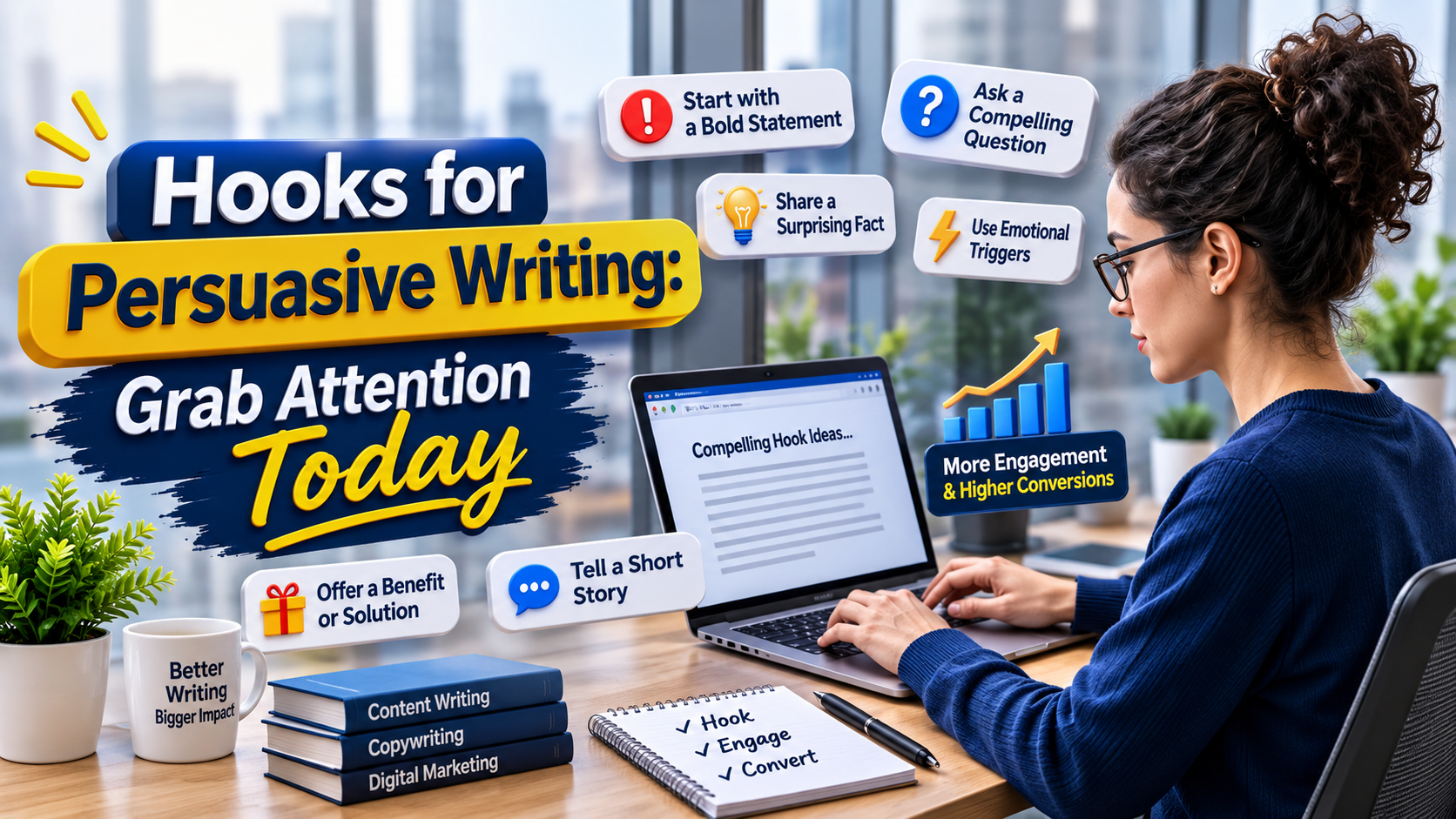
What Are Effective Hooks for Persuasive Writing?
Effective hooks for persuasive writing are opening lines that win the reader’s attention at once, using a question, a surprising statistic, a personal story, a bold claim, a quotation or a vivid image that points at the argument to come. MLC Presentation Design Consulting reports that speakers normally lose 90% of your audience within the opening minutes, and a written opening faces a similar race against a reader’s patience.
When I draft persuasive pieces, I write the hook last, after I know exactly which argument the reader must be steered toward. A hook chosen too early tends to describe the topic instead of provoking a response, and the draft then spends its next paragraph recovering.
The sections that follow treat each hook as a separate tool with a specific job. Some suit a written page, others a stage, and several travel well between the two, which is why the order below follows how the hooks behave in practice rather than how handouts usually list them.
Does a Question Make a Good Hook?
A question makes a good hook when its reply is neither instantly clear nor impossibly obscure, because that gap is what keeps the reader moving. George Brown College’s Tutoring and Learning Centre recommends a question that your thesis will resolve, or one that leads the reader toward it. Put the question up front and give the reader something to weigh straight away.
A question can carry numbers, too. A writer could ask how many injured young athletes receive hospital care, then supply the figure from the George Brown handout: of the youth hurt in sports and recreation, only 25% treated in hospital emergency rooms. A provocative question that pits two views against each other also creates the healthy conflict that the same handout says readers rarely resist.
Spoken openings add more options. MLC says rhetorical questions expect no reply, yet listeners’ minds start composing one anyway, so a beat of silence after asking helps. The same guide describes interactive questions such as raised hands and live polls, and simple sentence starters that ask whether the reader has ever faced the situation give a writer an easy way in.
How Do You Open With a Statistic or Shocking Fact?
A statistic hook opens with a surprising number from a credible source, which gives the claim the weight of Logos, the appeal to logic. George Brown College adds a rule that is easy to forget: cite your research, because an uncited figure reads as decoration.
MLC collects surprising facts under its “Did you know that…” formula, among them earthquakes shaking the Earth over 1 million times per year and 8% of people having an extra rib. Its plane-emergency example gives the scene a hard number as well: an explosion as the aircraft climbs past 3,000 ft. Another example attaches a date to a catastrophe, “about 10 years ago in Ukraine“, and the Keeling curve, which tracks rising CO2 in the atmosphere, shows how a single graphic can carry a statistic.
Topic matters more than shock value. A writer on type 2 diabetes or dental care needs a sourced figure, not a guess, and even personal settings such as AAU basketball weekends with 8 a.m. practices or a college orientation session gain force once something measurable is attached.
Can a Personal Anecdote Work as a Hook?
An anecdote works as a hook when a brief account of something real or imagined connects to the paper’s main point. ESU’s Writing Studio shows this in an essay about reaching the NBA: the writer recalls a stranger who trained in the gym before dawn and was later drafted, then links that history to the topic. The same handout also builds a quotation hook on Michael Jordan, which shows how one topic can host several different hooks.
A figure about 3 million youth injured every year in sports, taken from George Brown College’s examples, turns personal the moment a writer follows it with one injured player’s afternoon. In MLC’s account, plane-crash survivor Ric Elias opens by returning listeners to the event itself, and that is Pathos at work: the audience feels before it reasons.
A relatable story shows the reader they are in good company, while a compelling story keeps them reading to find out how it ends. In my own drafts, a three-sentence anecdote usually does more than a page of background, though that is observation, not a measured result.
How Do You Open With a Bold Statement That Challenges a Belief?
A bold statement hooks a reader by claiming a firm position in the first sentence and then spending the piece defending it. George Brown College advises challenging an opinion without offending the reader’s values, because a fair contest of ideas holds attention while hostility drives it away.
Prezi’s deck recommends calling readers out on a probable mistake, which prompts them to doubt their habits and reconsider them, and its sample statistic about Australians under 30 shows a claim riding on a number. A personal declaration can do the same work, as with the Korean-Canadian writer who says the hyphen in their identity often snaps in two. LessonUp offers a starter such as “It’s not fair that…” for claims driven by emotion.
Reversal is the cleanest version of the move. MLC quotes Bruna Martinuzzi on flipping a proverb: a journey to nowhere also starts with a single step. In MLC’s telling, Steve Jobs builds his audience’s expectation and then breaks it with an explosive surprise. Offer your own unique take rather than repeating a stance everyone already holds, and consider pairing the claim with a prop so the audience has something to look at while the claim settles.
When Should You Start With a Quotation?
A quotation is the right opener when the words come from a recognized voice, bear directly on your topic, and are explained right afterward. ESU’s Writing Studio makes the explanation step explicit: a quote left unexplained can leave the reader confused, and the statistic example there names Jeff Rabjohns of The Indianapolis Star before unpacking what the figure means.
An opening quote borrows credibility, which is a form of Ethos: the audience extends to you a little of the speaker’s standing. MLC offers sources for quotations and warns against letting Pinterest do the job for you. The aim is a relevant quote that supports the message, not one chosen only because it sounds impressive.
Turning a quote against itself challenges an assumption and sparks curiosity, since the reader wants to see how the reversal could hold. A dictionary entry is a quotation of a sort, but one that tends to feel flat, and George Brown College suggests restating such wording in your own words.
Is a Definition a Good Way to Start?
A definition is a good way to start only when it is phrased in your own framing, since a copied reference-book definition tends to read flat. George Brown College’s guide tells writers to restate definitions with a personal angle whenever possible, and it offers little reward for the obvious wording.
In that guide, the playwright George Bernard Shaw supplies a definition of teachers, “Those who can, do. Those who can’t, teach.”, which works because it is compressed and slightly provocative. A definition aimed at a specific group sharpens the effect, for instance one written for Canadians reading about national identity rather than for a general audience.
A definition phrased as a simile (“X is like…”) gives the reader an image to hold, and a definition can even set up a joke, although humor needs the care described later in this piece. My own test is simple: if a definition could appear unchanged on any website, I rewrite it until only this topic could have produced it.
How Do You Make an Opening Feel Relatable?
An opening feels relatable when it names a situation, worry or habit the reader already recognizes, so the rest of the piece looks relevant before it begins. Prezi’s persuasive-writing deck advises sharing a problem so readers see how genuine you are and engage with you.
Prezi’s deck also poses a question about how much a reader would pay to save a loved one, which works because the stakes are personal. The fear of being parted from a phone, nomophobia, is relatable in the same way, and a call-out telling readers they are probably addicted to sugar leans on a habit many will recognize. Its expectation example promises talk about the value of a good sleep.
I often see reviews open with a shared irritation, because a reviewer who starts with a complaint the reader has felt earns a hearing. George Brown’s anecdote sample features a supermarket cashier sorting customers by how they treat staff, and LessonUp lists “Teachers and parents agree that…” as a starter that taps group consensus. MLC describes a shared problem as a quick route to resonance, provided the problem is relevant to the audience.
How Does an Opening Metaphor Work as a Hook?
An opening metaphor works by letting the reader look at a familiar topic through an unfamiliar image, which makes the topic feel new. The word hook is itself a figure of speech: LessonUp compares it to the hook on a fishing rod, and George Brown College extends the comparison to an angler choosing a hook for a particular fish.
MLC says a surprising metaphor can help an audience grasp complex ideas, and Prezi’s deck gives a vivid case by describing ages 14-16 as playing a video game whose rules you never read. MLC’s guide, meanwhile, cites the idiom “a picture is worth a thousand words” to show how one image can carry what a paragraph cannot.
Metaphors need care. Avoid a worn cliché, or bend it, as George Brown suggests with a new spin on an old line. In practice I test a metaphor by asking whether it survives being explained in one sentence; if it needs a paragraph, it has stopped being a hook.
Should You Tell Readers What They Will Gain Early?
Telling readers what they will gain early works because it shows them the piece deserves their attention before they have invested any of it. Prezi’s persuasive-writing deck says that letting readers know the payoff raises the chance they will keep reading, and it frames persuasion as something people do nearly every day, in advertising as readily as in an argument.
A promise must carry relevance for the reader, so it works best when it names a concrete payoff. George Brown’s sample line about three myths works partly because the count tells the reader how much is coming. A product pitch that moves past a bare exchange of funds for goods shows what else the buyer gains, and a writer selling solar panels, in a hypothetical sample of mine, might promise how to cut a household energy bill by the end of the page.
Spoken versions work the same way. MLC suggests painting a desirable scenario the audience would actually want, and it describes a talk on Apple Siri that skips the feature list and shows the assistant at work. A listener who knows the payoff is more receptive to the details that follow.
How Do You Trigger the Reader’s Imagination?
An imagination hook asks the reader to build a scene mentally, usually through a command such as “Imagine…”. LessonUp lists that opener alongside “Many kids feel…” as a way into emotional writing, and the scene need not be real: ESU allows a story that is a figment of your imagination, provided it supports the main idea.
Honesty matters, though. MLC warns that an audience which suspects it is being tricked stops believing the speaker, and presenting an invented scene as established fact lies to the reader. Label hypothetical scenes as hypothetical and the hook keeps its force.
Imagery can be small. Prezi’s comparison of life to a box of chocolates shows how a familiar image prompts a picture before any argument arrives. In speech, the rhythm of voice matters as much as the words, and a deliberate pause after the command gives listeners time to picture the scene.
What Happens If You Open With the Problem?
Opening with the problem makes the audience curious about the solution, provided the problem is one they actually share. MLC recommends describing the difficulty plainly, and its sample opener reports that a rival overtook the company this year while the speaker’s side had nothing to return fire with.
Because persuasion exists to influence people, a problem-first opening fits it naturally, and the problem can be physical as well as financial: George Brown’s cockroach example pairs a pest with a health threat. MLC’s metaphor story about hidden costs shows a manager naming a danger beneath the surface, which then fuels a brainstorming session.
A what if opener can turn the problem around, as in MLC’s example of a world where cancer deaths stop today. History supplies problems too: MLC’s date-based example recalls a catastrophic nuclear accident to give a board a reason to care. A well-framed problem tends to start discussions rather than end them.
Can an Image or Video Work as a Hook?
An image or video works as a hook because it puts the subject in front of the audience instead of asking them to imagine it. MLC calls this bringing the subject to life, and it applies in print as well as on stage: even in persuasive letters, a vivid detail helps readers visualize the situation, such as a gym lit up at 5:30 a.m.
Pairing a quote with a picture of the author lets a speaker inherit the author’s values, according to MLC. In MLC’s example, a president asks what sank the Titanic, then displays an image of an iceberg to expose the company’s buried costs. Seth Godin describes the ideal slide as one that triggers an emotional reaction and makes the audience want to hear what fits the image.
The iPhone keynote in MLC’s guide ends its buildup with the reveal that three products are really one device. MLC’s own classroom gag is an ugly slide followed by a picture of a sleeping audience, which got a laugh.
Is Humor a Safe Way to Open?
Humor is not a safe opening, because a laugh line depends on timing and on a room that shares the moment. MLC admits an audience can miss the punchline entirely and recommends simply moving on, since a failed laugh does not ruin the talk.
A funny opening acts as a lure, and the wrong bait on the wrong day catches nothing. Humor at someone’s expense is rude and risks alienating the very people you want to persuade. Woody Allen shows the safer form, a twist on a known line: in George Brown’s guide he takes a famous definition of teachers one step further.
MLC’s guide quotes an energy keynote that makes dark humor out of winning the Darwin Award. Calendar-based openers, like MLC’s CEO scenario set on the 26th of April, suit sincerity better than comedy. MLC’s strategy resource lists real-world examples, common pitfalls and likely effects for each hook, which is a useful check before any funny line goes into a draft.
Can a Historical Event Anchor Your Opening?
A historical event can anchor an opening when the date or incident gives the audience a reason to care about the work in front of them. In MLC’s example, the CEO of a renewable-energy company, speaking to a board after a bad financial year, uses that day’s date to recall a catastrophe from about 10 years earlier.
The anchor must be accurate and relevant. George Brown’s hygiene example puts a number on risk: a household pest can carry more than 40 pathogens. An energy keynote quoted by MLC leans on the world’s reliance on fossil fuels for the same reason, and MLC’s account of a product keynote treats launch history as an anchor, since the iPod was the first of three products announced.
Know your audience’s memory. George Brown notes that students do not always remember what they were told at orientation, which is a caution against assuming a shared past.
Which Kind of Appeal Should Your Hook Lean On?
A hook should lean on emotion, credibility or logic depending on the reader and the claim, and LessonUp’s lesson maps each appeal to a group of openers. Its running question is whether a longer summer break is warranted, and the right appeal depends on whether the writer wants to engage emotionally, establish standing, or present evidence.
The table below compares the three appeals by focus and typical opener.
| Appeal | What it leans on | Typical opener |
|---|---|---|
| Emotion | Feelings and imagination | “Imagine…” |
| Credibility | The writer’s voice and standing | “From my own experience…” |
| Logic | Facts and reasoning | “Studies show…” or “On average…” |
The writer’s tone should match the appeal: a strong opinion can carry a bold, emotional opener, while a researched claim wants a calmer register. Whichever appeal you choose, the reader should be able to relate to it.
How Quickly Do You Lose an Audience Without a Hook?
An audience can drift away quickly without a hook, because attention does not stay level for the length of a talk. MLC makes the point that an hour of presenting is not an hour of attention, and that a weak opening can make listeners lose interest before the message arrives.
A hook therefore works on a short clock. A number such as the 0.00545 percent in ESU’s statistic example stops a reader quickly, and the Forbes remark quoted by MLC, that the right quote resonates for days, weeks, even years, explains why a quote rewards the effort. A picture’s processing time is short, which is why MLC says attention returns fast after an image.
Evidence-led openers such as “Data from schools shows that…” hold readers who want proof. Sir Ken Robinson‘s TED talk, at 40.2 million views, shows that a plain preview of two topics is enough to maintain focus. A rival beating the company on revenue is the kind of stake that keeps managers listening, and an anecdote ending with a draft by the Philadelphia 76ers carries listeners to its close.
Can You Combine More Than One Hook?
Combining hooks works when each technique does a separate job, such as a question that wins attention followed by a story that builds trust. MLC states plainly that nothing stops you from combining techniques to craft a distinctive opening.
George Brown’s guide compares the writer to a fisherman who thinks about the fish before choosing the hook, which is the case for matching hooks to the reader. ESU’s statistic hook could pair its 550,000 boys figure with the basketball anecdote elsewhere in the same handout, and MLC’s problem-first sample, in which Competitor A overtook the company, could be preceded by a short question.
A product demo can serve as the visual half of a combination, and a CEO addressing board members might open with a date and follow with a problem. MLC also adds a pre-hook: interact with the speakers who go before you, then link your opening to what they said.
How can I keep my audience engaged throughout a presentation?
You keep an audience engaged by opening with a hook and staying interactive, because MLC treats the first 5 minutes as the critical window for capturing attention. Ask questions and give the room an answer to look for, and tell a story that ends with hard work paying off so the point stays memorable. Cordell‘s approach, cited by MLC, is to tell people what the topic is, what they need to know and what to do. Interaction creates a dynamic environment, and the aim is to motivate changes in how listeners act. Keep delivery from going dry, and if a laugh line gets no reaction, move on without comment, because a talk that does all of this becomes impactful.
What is the importance of a presentation hook?
A presentation hook matters because it decides whether the audience stays with you or drifts away in the opening moments. Hooking is a skill that can be learned, and MLC cites an attention chart from Sequoia Capital to show that 60 minutes of meeting time does not deliver a full hour of attention. A hook that tells readers what they get signals the piece is worth their time, and Prezi’s call-out version makes them question themselves. MLC’s hypothetical cure for cancer shows the scale of stakes a speaker can build toward, and Prezi’s sample statistic cites News.com.au, a reminder to attribute every figure.
Can storytelling be an effective hook for a presentation?
Yes, storytelling is an effective hook because a personal or relatable account builds an emotional connection between speaker and audience. You do not need born talent for it, since MLC notes that a story is common to everybody and easy to follow. Prezi notes that sharing a problem shows how real you are, and MLC says video can convey a whole emotional environment. LessonUp’s opener “As a student who…” signals lived experience, and in MLC’s guide Alan Watts combines a couple of questions with a personal story drawn from his teaching.
How can I involve my audience in the presentation?
You involve an audience by turning listeners into participants: ask them to vote by raising hands, link your talk to what other speakers said, and show you were an active listener. MLC says that connecting to earlier speakers turns separate speeches into a dialogue, and an opener such as close your eyes and imagine hands the room an active job. A short story from ESU’s guide, a quote traced through the Yale Book of Quotations, or a metaphor that makes ideas accessible each give people something to react to. Tell them what to expect to save them time, bring a trailer if emotion matters, and feel the moment before attempting humor. A historical link can give meaning to their work, and stories humanize the speaker.
What are some examples of presentation hooks?
Examples of presentation hooks include a surprising statistic, a famous quotation, a personal story and a challenge to a common belief. ESU’s statistic hook rests on odds of 1 in 18,333 for a high school player becoming a first-round draft pick. A foreign proverb, such as the Italian one MLC uses for a yellow-umbrella company, can freshen a quote, and a quote can be restated as a paraphrase. Elon Musk opens his Tesla Powerwall talk with a problem the whole world shares, and MLC’s Hooking Strategy Map collects further options that set the stage for a successful presentation.