

Site Retargeting vs Search Retargeting: Can We Get Free Visitor Scan Now?

Site Retargeting vs Search Retargeting: Which Should You Use?
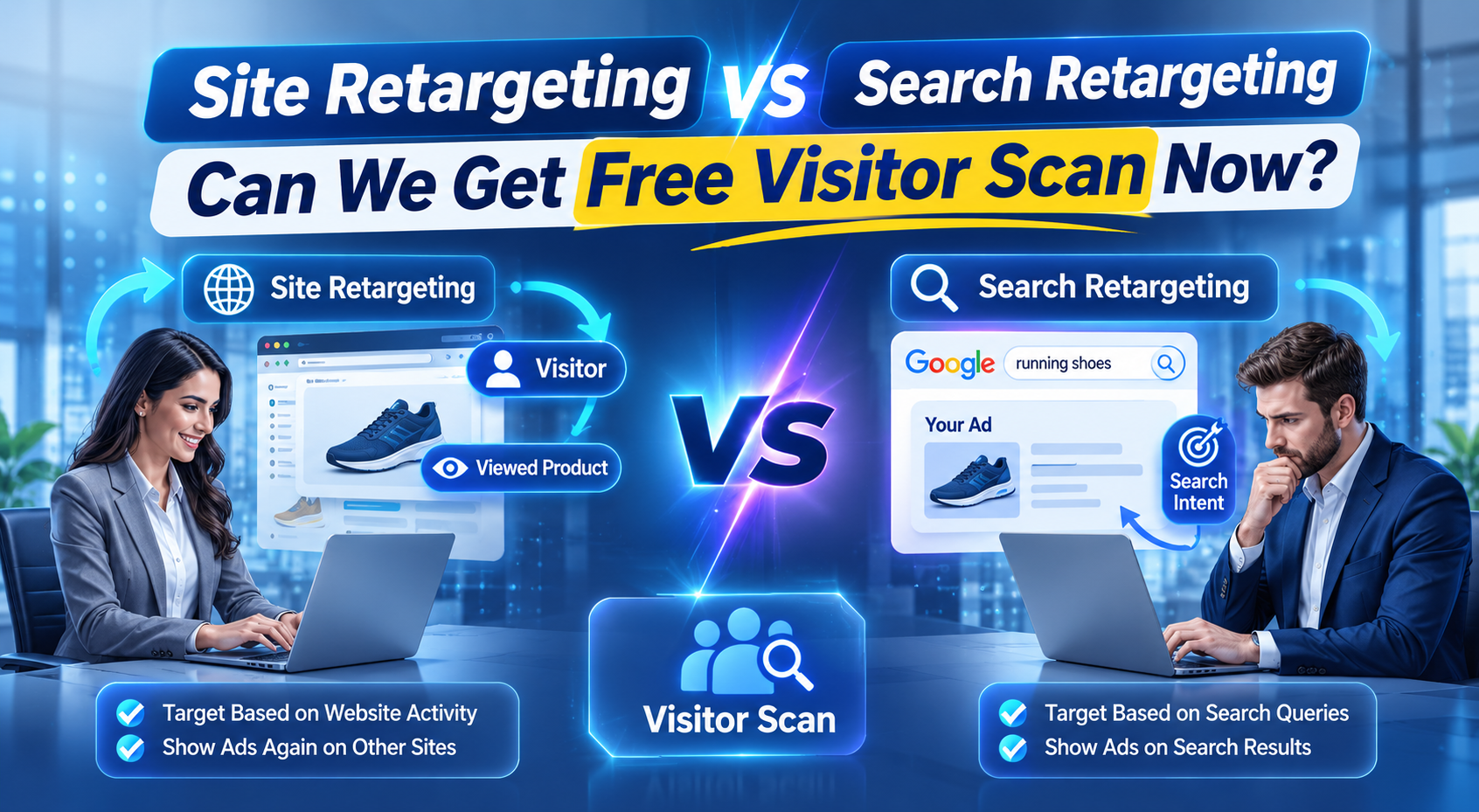
The main difference between site retargeting and search retargeting is audience type: site retargeting follows people who already visited your website, while search retargeting follows people whose searches suggest they want what you sell. Site retargeting works near the bottom of the purchase funnel and search retargeting works near the top, which is why most advertisers eventually run both.
In online advertising, the two tactics get lumped together because both trail a person across the web, yet they start from opposite signals. Site retargeting depends on a single pixel that drops a cookie during a visit. Search retargeting depends on search activity, usually surfaced through Google Ads audiences, captured during the research phase before anyone has picked a seller.
I noticed the split on a client account where checkout numbers looked healthy but traffic had stalled. Site retargeting was recovering window shoppers, helped by brand recognition from their earlier visit, yet it could never produce new customers. That job belongs to search retargeting, which handles unknown customers with a clear purchase intent, while site retargeting handles visitors with unknown purchase intentions. Treating acquisition and conversion as separate jobs cleared up most of the confusion.
What Is Search Retargeting and Who Does It Reach?
Search retargeting is a form of digital advertising that serves display ads to people browsing the web based on their search behavior instead of any visit to your site. The advertiser chooses the terms, and keyword searches or search history tied to a specific product or service trigger the ads. That puts search retargeting at the top of the sales funnel.
The people it reaches are cold leads, but cold is misleading because their intent is visible. Many are motivated buyers, which is the reverse of known prospects, whom site retargeting recognizes from an earlier visit. A Salesforce study cited by Digital 2 Dealer found that as of 2018, 87% of shoppers started their product search online.
Cost is the practical draw. GMS Digitals says search retargeting can deliver up to 96% savings per click compared with traditional search ads, and Digital 2 Dealer reports it often runs for less than $1 per click, which can supplement an SEM campaign when keywords get expensive. Interest is growing too: a Chango report found just over 65% of surveyed marketers planned to raise retargeting budgets within six months.
Why Does Site Retargeting Bring Visitors Back to Buy?
Site retargeting brings people back by showing ads to those who already visited a website, expressed an interest, and then left. These visitors are warm leads who know the brand, so site retargeting is not keyword-based and does not work as an upper funnel prospecting strategy.
A small piece of code tags website visitors in their browser, and later ads can remind them about items left in shopping carts. Criteo says the ROI of site retargeting is often extremely high because the audience already recognizes the company. The audience is a smaller audience by design, yet it is the group closest to producing conversions.
Criteo describes the goal as helping to convert browsers into buyers, and the approach is cost-effective because budget goes only to people who already showed interest. The aim is to convert visitors who hesitated. Set a time limit on each audience; GMS Digitals suggests 30 days for most businesses. Send returning clicks to a relevant landing page on a mobile-friendly website so the reminder leads somewhere useful.
How Does Search Retargeting Find Buyers Who Have Never Visited Your Site?
Search retargeting finds buyers by watching what people look up in search engines such as Google and Yahoo, then following them with ads elsewhere. Criteo’s example is a furniture retailer targeting people who searched leather couch or leather sectional, and Business-Software.com offers calcium supplements as another case. In both, the advertiser reaches a prospect who has not yet heard of the seller.
Search retargeting does not wait for a first visit. GMS Digitals notes that only 2% of people buy on a first visit, leaving 98% who need more time, and search retargeting can meet many of them earlier. It can also reach competitors’ customers, which gives the advertiser early brand exposure with actively interested users. That exposure can later turn the prospect into one of your customers.
In a cost comparison, search retargeting supplies fresh prospects at a lower click cost than search ads. It builds a specific audience purely from search signals, whereas site-based scoring can add keywords searched before visiting as one more signal. Keep relevant ads matched to the search, skip generic ads, and check how they appear on mobile devices.
How Does Site Retargeting Track Visitors After They Leave?
Site retargeting tracks visitors by tagging a qualifying activity, such as viewing a product page, so ads can follow the person after they leave. When a visitor left without purchase, a basic retargeting campaign shows the most recently viewed product, as Criteo describes. That makes the method conversion-focused and a direct answer to cart abandonment.
Frequency matters as much as the tag. GMS Digitals suggests frequency caps of once or twice a day, since more than that feels like stalking. Add exclusions so existing customers stop seeing ads, and watch clicks and sales to learn which ads earn their place.
Signals from the site also show funnel stage and interest level. A 2026 research paper models abandonment at both upper and lower stages of the funnel. A store with steady website traffic but weak sales is the usual candidate for this tactic.
How Do Site and Search Retargeting Differ Side by Side?
Site retargeting and search retargeting differ in who they reach, which signal they use, and where they sit in the funnel. The two often get filed under one blanket term, yet the choice is not either/or, because each answers a different part of the buyer’s path. Site retargeting speaks to people familiar with your brand, while search retargeting speaks mostly to strangers.
| Factor | Search retargeting | Site retargeting |
|---|---|---|
| Audience | People who searched and may never have visited | People who visited and left |
| Funnel position | Upper stage, discovery | Lower funnel, conversion |
| Targeting tools | Topic-based targeting, Custom Intent audiences, Custom Affinity audiences, AI audience building | Programmatic site retargeting |
| Cost driver | Display placements rather than click auctions | Spend limited to past visitors |
On price, Criteo explains that search retargeting runs on display inventory, which is often cheaper when bidding wars push up cost per click in PPC campaigns for highly competitive keywords.
Budget questions follow from this. Both options compete for the same marketing budget, and new site visitors come mainly from search-based audiences. A 2026 paper in the Journal of Business Research by Jiang, Narasimhan, and Turut builds an analytical model of both approaches, and its listed keywords include game theory.
Should You Run Site and Search Retargeting Together?
Yes, running both is usually the stronger plan, because the two dominant approaches cover different stages of the funnel. Digital 2 Dealer’s dealer example shows how: a buyer searches Chevy Tahoe Lease, reads Ford Expedition comparisons, watches YouTube test drives, and works out cost of ownership. Search retargeting meets that buyer during the research, and site retargeting can re-engage them after a dealership visit.
Programmatic tools add depth with data points such as time spent on the site, pages visited, and photos or videos watched, which together estimate a visitor’s value. That depth is what separates sophisticated retargeting solutions from a simple tag.
SkillXcel Tech suggests this order:
- Start with search retargeting when brand awareness is the gap, and judge it against your campaign goals.
- Add site retargeting when traffic is steady but you see low conversions.
- Measure results by ad: test several ad versions, different headlines, images, and calls to action, then double down on what works.
Which Retargeting Practices Work and Which Mistakes Waste Budget?
The practices that work are relevance, restraint, and measurement, while the costly mistakes are almost always tagging and targeting errors. Criteo notes that dynamic creative optimization and product recommendations can deliver personalized ads shaped by shopper preferences. Digital 2 Dealer shows the same idea outside retail: a Subaru dealer can promote PZEV models to outdoor-minded buyers, and someone on vintage Chevy forums doing a Chevelle restoration can see ads for original parts.
Creative quality also counts. Criteo says display lets advertisers build visually impactful ads and branded ads that PPC campaigns cannot match. Smaller advertisers competing with bigger brands can lean on this, since a decision often hinges on which message arrives at the right moment. A balanced strategy keeps all bases covered instead of leaning on one tactic.
Business-Software.com warns that tagging every page buries visitors in irrelevant ads, so tag only the pages that matter to the sale.
| Mistake | What goes wrong | Fix |
|---|---|---|
| Tagging every page | Irrelevant pages trigger pointless ads that feel like invading privacy | Tag product pages, download pages, and coupons only |
| No conversion tracking | Buyers keep seeing ads after they purchase | Track purchases and exclude buyers |
| Unchecked ad pressure | Visitors feel followed | Cap how many times each visitor sees ads |
What Is the Difference Between Search Retargeting and Site Retargeting?
Search retargeting targets people based on keywords they searched, while site retargeting uses cookies to target people who visited a site, according to Red Shark Digital. Retargeting has become a mainstay of ad strategy, and both are effective methods with different advantages and disadvantages. Search retargeting can draw on hobbies and life changing events such as weddings or children to find buyers. Choosing how to split spend is a resource allocation question, and the 2026 paper also discusses pricing strategies and product innovation.