

How Marketing Agencies Work: Inside the Process from Start to End Today

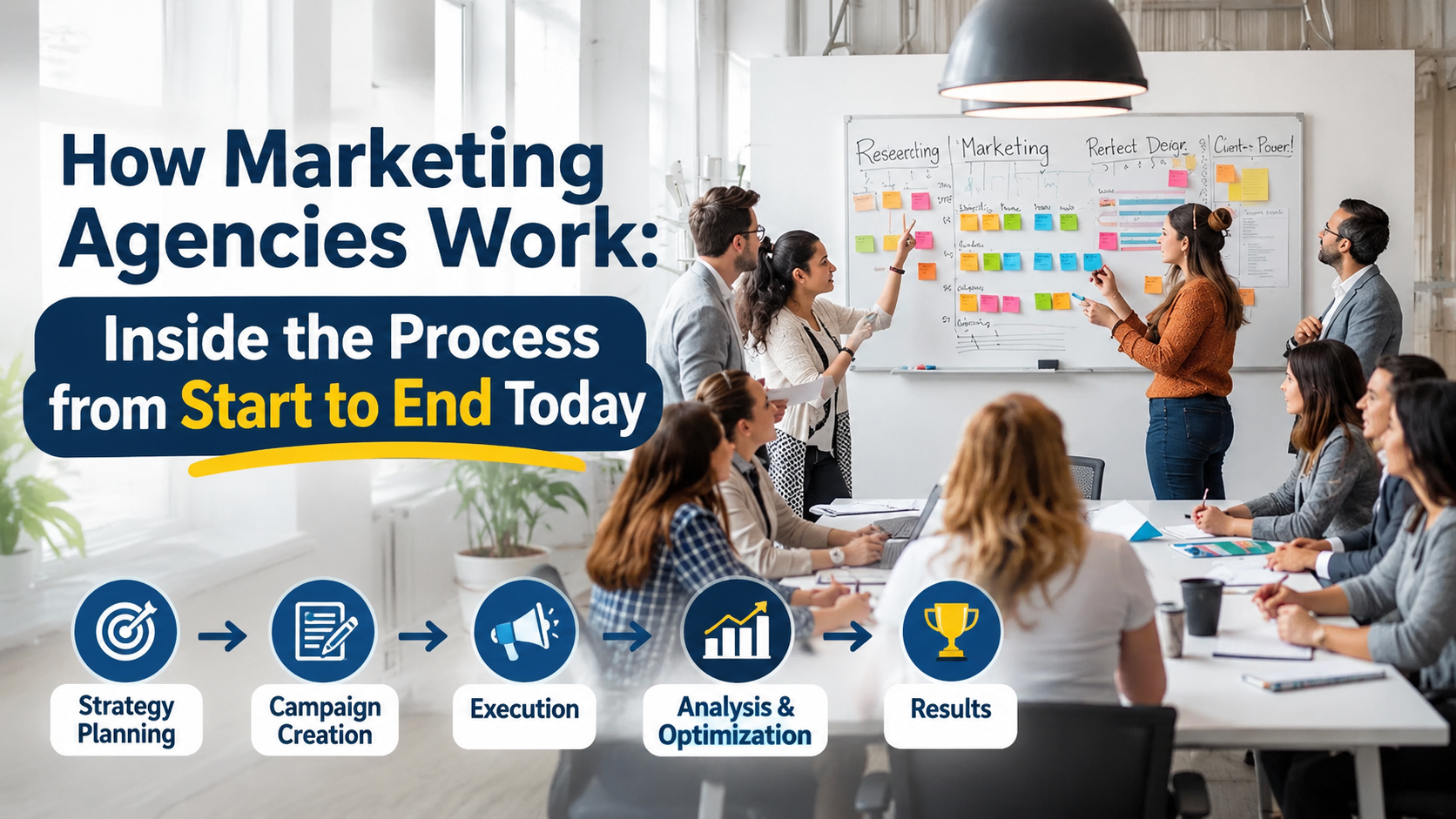
How Do Marketing Agencies Work?
A marketing agency works as an outside team of specialists that plans, builds, and runs the marketing that gets a business found, remembered, and chosen, combining strategy, creative work, and paid and organic channels under one plan.
Most agencies begin by learning what a client sells and who buys it, then divide the work among strategy, creative, and channel specialists. The better ones behave like growth partners rather than order-takers, which is why the working relationship matters as much as any single tactic.
The usual trigger is scattered marketing: a website here, a social account there, and nobody steering. A digital marketing agency steps in with strategic advice, a fresh perspective, and the campaign execution capacity that one marketing hire rarely covers alone. That is the real contrast with in-house marketing built one role at a time.
What a client pays for should be judged by outcomes and ROI, not by how busy the activity looks. Any budget spent on weak marketing buys little, and over the past decade, channels such as Facebook have multiplied the places that money can go. In my experience, that coordination is the part clients undervalue.
What Exactly Is a Marketing Agency?
A marketing agency is a team of marketers who work together to help a client attract customers through various media.
Unlike a single individual, an agency assembles planners, makers, and creative directors into one bench. When a skill isn’t kept on staff, some agencies hand that work to freelancers, so parts of the job are outsourced even when the client sees only one name on the invoice.
What an agency covers depends on its included services. A narrow shop stays in one lane, while an integrated agency works with a wider remit, from customized marketing plans to the reports that show what happened afterward.
The value usually appears where a business has a gap between doing marketing and seeing it work. An agency brings broad expertise and lessons from successful campaigns to that gap, and the aim is to address a business problem, not to sell from a catalog.
What Services Does a Marketing Agency Actually Provide?
A marketing agency provides strategy, branding, website work, SEO, graphic design, and email, social, and ad management, usually in some combination.
Strategy sits under everything else, and the agency carries out the work that follows. Website designers and a developer build the site, while graphic design covers marketing collateral, print, and even billboards, all kept consistent by brand guidelines.
Some clients need only one channel, such as paid ads or outreach for public events. Others buy bundled services, and the complexity of that mix is what turns a pile of tools into a system someone is actually steering.
Before committing, ask for a portfolio and note whether the agency starts with foundational work, such as research and positioning, or jumps straight to making assets.
How Does a Marketing Agency Build a Strategy for Your Business?
A marketing agency builds a strategy by defining who the business wants to reach, what to say to them, and where to spend, before choosing any tactics.
The big picture comes first. The agency identifies target customers, runs competitive research to find strengths and weaknesses, and sets a brand strategy so every later message points the same way.
That groundwork feeds a multichannel marketing strategy, and the creative lead turns it into campaign ideation. The marketing manager on the client side reviews recommendations against milestones, which keeps ongoing strategy tied to results instead of drifting.
Strategy also decides whether a business can scale. When a company hits a growth ceiling, outside consultants or an agency can say what to build next, not just what to post.
How Does a Marketing Agency Handle SEO?
A marketing agency handles SEO by researching the keywords buyers use, improving the site and its content to rank for them, and reporting on what moves.
An SEO specialist starts with the target audience: what they search for and what answers they expect. The site then has to deliver a good user experience, whether it runs on WordPress or another platform, and blogs supply content for those questions.
Many agencies treat a new website or a website that doesn’t bring leads as the first fix, because digital advertising sends traffic to a page that has to convert it. Performance analysis then shows which pages earn their place, using analytics subscriptions and reporting tools.
Upwork’s list of vetting questions asks what business results to expect in 90 days, which is a fair way to test the time it will take to see movement. Agencies may also bill hourly rates for this work.
How Does a Marketing Agency Run Paid Ads and Social Media Campaigns?
A marketing agency runs paid campaigns by choosing the platforms, building the creative, buying the placements, and adjusting based on results.
Paid advertising puts a message in front of people quickly, while organic search builds visibility more slowly, so agencies usually combine both. A proactive agency treats paid media and social posting as one system and brings creative solutions instead of recycled templates.
A typical campaign moves through these steps:
- Set the campaign size and the depth of work the agency will take on.
- Build the ads and digital information content, then collect approvals from the client.
- Handle media purchasing, remembering that outsourced work can arrive as pass-through costs.
- Go live on launch day and allow ramp-up time for tuning before judging results.
Done this way, the campaign leaves a stronger impression than scattered posting.
How Does a Marketing Agency Measure Results?
A marketing agency measures results by tracking the metrics that connect campaigns to leads and sales rather than to reach alone.
Impressions show how many people saw an ad, which is useful but incomplete. A transparent agency also reports on the pipeline and on whether the work is helping to bring in customers, using agency-level tools that a small team may not license separately.
Measurement starts before launch: background research and market research set a baseline, and the customer journey shows where to look. The agency’s experience level matters here, because a team that has measured TV campaigns before has a better sense of which numbers deserve attention.
Channel data keeps the direction honest. BrightEdge publishes channel-share research that helps agencies see where traffic originates, and every change in campaign performance should stay aligned with customers and their actual behavior.
What Types of Marketing Agencies Are There?
Marketing agencies range from a full-service agency that covers strategic planning through delivery to narrow specialists in areas such as public relations or local SEO.
Multi-service agencies take in the whole picture, while a specialist might own one skill set, such as PPC, and stop there. An independent freelancer sits at the small end, usually serving one client or a handful.
Choosing a type depends on agency size, the KPIs that matter to the business, and its new growth stage. Upwork’s Project Catalog is one place to compare freelancers and agencies. Even simple items like flyers sit inside some agencies’ scope, so ask what the agency actually covers.
What Are the Benefits of Hiring a Marketing Agency?
Hiring a marketing agency gives a business access to outside experts and a team that can run campaigns without growing payroll.
Outside experts know how to reach digital audiences: around 31% of American adults are online nearly all the time, according to a study cited by Upwork. Agencies build awareness where those people already are.
Agencies also handle both strategy and daily work, from managing accounts to A/B testing, content strategy, and tuning conversion rates. The same team already knows ideal customers from prior engagements, which saves a business from rebuilding that knowledge.
Cost is part of the case. A predictable fee can mean an agency costs less than assembling the same skills, and specialist agencies or a hands-on generalist can fit different budgets. SEO no longer has to sit in a supply closet of undone tasks.
How Does a Marketing Agency Compare With an In-House Team?
A marketing agency supplies a ready-made team of specialists on contract, while an in-house team is hired directly and works only for one company.
An in-house team focuses on driving sales for one brand and understands the product deeply. That focus has a price: the business pays for talent acquisition, and one busy manager may be wearing six hats. Freelancers working on their own can plug some gaps, but not all.
An agency brings strategists, keyword research, Google Ad Manager know-how, and marketing calendars as part of recurring monthly work. Over time, a good team tracks customer acquisition cost and loyalty so it can show what the spend returned.
| Factor | Marketing agency | In-house team |
| Skill range | Specialists across strategy, design, and search, ready immediately | One role added at a time |
| Time to launch | Working from day one | Weeks to months of recruiting and ramping |
| Cost structure | Predictable project-based pricing | Fixed payroll plus tools and management time |
| Flexibility | Adjusts as needs change | Fixed team size regardless of workload |
Building a team in-house historically made sense when a company had steady work for every role. The hiring decision looks different when that is not true.
Who Does What Between the Client and the Agency?
The client sets business goals, supplies brand information, and signs off on work, while the agency handles strategy, creative production, research, and campaign management.
The agency’s creative team handles content creation, from television commercials and magazine ads to page titles and email copy. Because that work is only as good as its brief, the client’s job is to share goals clearly and keep availability for questions.
On the data side, agencies use CRM software and custom audiences to understand behavior, and some manage media relations for press coverage.
An agency gives an unbiased outside view, which helps when messaging has become outdated. Before signing, decide whether you want a team to build and run it all or only part, and weigh the team it would take to do the same internally.
How Do Marketing Agencies Price Their Services?
Marketing agencies price their services by the hour, by the project, or through an ongoing monthly arrangement, with the total shaped by expertise and the depth of services.
Pricing follows the scope of work. A modest project size might be a site built on a website builder, while a larger engagement spreads copywriting, technical SEO, and campaign management across one plan.
Building the capability internally adds recruitment expenses and individual licenses for tools. Hiring writers and other specialists one at a time can cost more than a single agency, while SEO agencies that focus on one channel can be cost-effective when search is the only gap.
Spending decisions made early matter. In a launch, the first 24 to 48 hours are when agencies watch results closely and adjust. Formats like Performance Max and metrics such as CPM show up in reporting, which matters when customers are almost constantly online.
How Do You Choose a Marketing Agency Worth Hiring?
A marketing agency worth hiring starts with your goals rather than its packages, shows results as well as output, and communicates like a partner.
Look at brand familiarity: has the agency worked with businesses in your category? Check whether trained marketers staff the account and whether its campaign graphics show conviction rather than generic polish.
Ask about specialized resources and channel know-how, from TikTok to the Search Generative Experience, because discoverability is shifting as AI-driven search spreads.
Once you shortlist, judge lead quality against promises, compare brand and creative agencies with broader teams, and use the onboarding meeting to confirm roles. Clarify any retainer agreements before signing. The decision should come down to fit and whether the agency’s approach can match your needs.
What Do Marketing Agencies Do?
Marketing agencies create and manage the marketing that attracts customers, covering strategy, brand design, SEO, content, and paid media.
Their work spans web development, on-page optimization, and video on YouTube, with the aim of increasing visibility across advertising channels.
Many agencies use a full-funnel approach, reporting on ROAS and organic traffic so the client sees what the activity returned. A social media marketing agency may concentrate on one slice of that work, and the team that connects every slice is the one that pulls ahead.
Upwork lists services such as email, content, and SEO. Pricing typically follows project-based fees or monthly arrangements, and the benefits include guidance from specialists who have done similar work.
How Much Does a Marketing Agency Cost?
Bryckroad reports that ongoing monthly agency work typically runs from $2,000 to $10,000 or more, depending on what is included.
Costs rise with deliverables. A Squarespace setup built around the client’s brand is a smaller job than a plan that adds backlinks, analysis software, and paid placements like TopView.
Specialty work such as crisis management can push a proposal higher, and reporting on CPL adds analysis time. For comparison, an in-house employee’s salary is only one line in total cost.
Pricing also depends on where the work sits in the buyer’s consideration stage, because mid-funnel content takes different effort from awareness ads. A quote should be compared with what traditional marketing strategies would cost for the same reach.
What Is the Difference Between a Marketing Agency and an Advertising Agency?
An advertising agency focuses on paid media such as TV, radio, print, and digital ads, while a marketing agency covers a broader scope that adds brand strategy, web, SEO, content, and design.
A marketing agency handles branding, brand identity, and email campaigns alongside ads, and it may launch new products with Branded Hashtag Challenges on social platforms. Many agencies now cover both.
Reach is judged differently. An advertising-first agency may report vanity metrics such as views, while a marketing agency ties work to revenue. BrightEdge research puts organic search at more than 53% of all website traffic, so SEO and content can shape interest that paid ads alone don’t capture.
Day-to-day, the account manager coordinates the work, and teams may need training on tools. For enterprise-level builds, a company may want both disciplines, and the choice depends on the agency’s point of view about what should drive growth.
When Should a Business Hire a Marketing Agency?
A business should hire a marketing agency when the people on staff can’t keep up with marketing demand, when the brand or website no longer reflects the business, or when growth has stalled.
Typical signs include dated logos, a site that isn’t mobile-friendly, or a pre-launch push with nobody to coordinate it. A second set of eyes from an agency can spot those issues quickly.
If retargeting exists but CTR stays low, and no one owns the numbers, that is another cue. Agencies, from a PR agency to a broader team, can solve that by taking ownership, while a relationship manager on the client side keeps the work moving.
Check the upfront cost against what a full-time hire costs, and ask for references from the agency’s current client base. Bryckroad argues that for businesses at the $1M+ level, weak or inconsistent marketing almost always costs more than hiring help, even when the work extends to outdoor signage.
What Is the Difference Between a Marketing Agency and a Marketing Consultant?
A marketing consultant is typically one person who provides expert counsel, while a marketing agency is a team that both advises and carries the work through.
An agency can cover post-launch monitoring, site speed fixes, and CPC optimization because its team spans disciplines, whereas a consultant’s reach ends where one person’s skills end.
A consultant can offer agility and a lighter headcount footprint, and a promotion agency or other specialist can sit between the two. More frequent feedback loops are common with consultants, though that is an observation, not a measured fact.
A team can also manage paid social, where 1.93 billion people use Facebook daily, according to Upwork. If in-house capacity exists, a consultant may be enough to run strategy. Agencies that outsource work typically add 30% when passing those costs on, so check the agency fee and start with a small paid task. Even radio buys need someone to execute.
Is It Cheaper to Hire a Marketing Agency or Build an In-House Team?
For most growing businesses, a marketing agency costs less than the in-house team it would take to match, according to Bryckroad, though in-house pulls ahead once there is full-time work for every role.
Agency pricing varies, but a single contract replaces several hires, whereas each in-house role adds overhead. Complex builds can reach six figures, so compare like with like.
Good agencies set up check-ins and report on measures like customer lifetime value, so the savings are real instead of assumed.
The alternatives are often informal. A nephew who is good with computers can design a flyer but not manage earned media, make a site easy to crawl, or build lookalike audiences. Agencies with a visual identity system and a shared business philosophy keep other business activities from being derailed, while advice that only tells you what to do leaves the work with you. The blurred lines between agency, consultant, and freelancer mean the real test is who does the work.