
Google Ads vs Meta Ads: Which Platform Delivers Better Benefits & Key Differences?

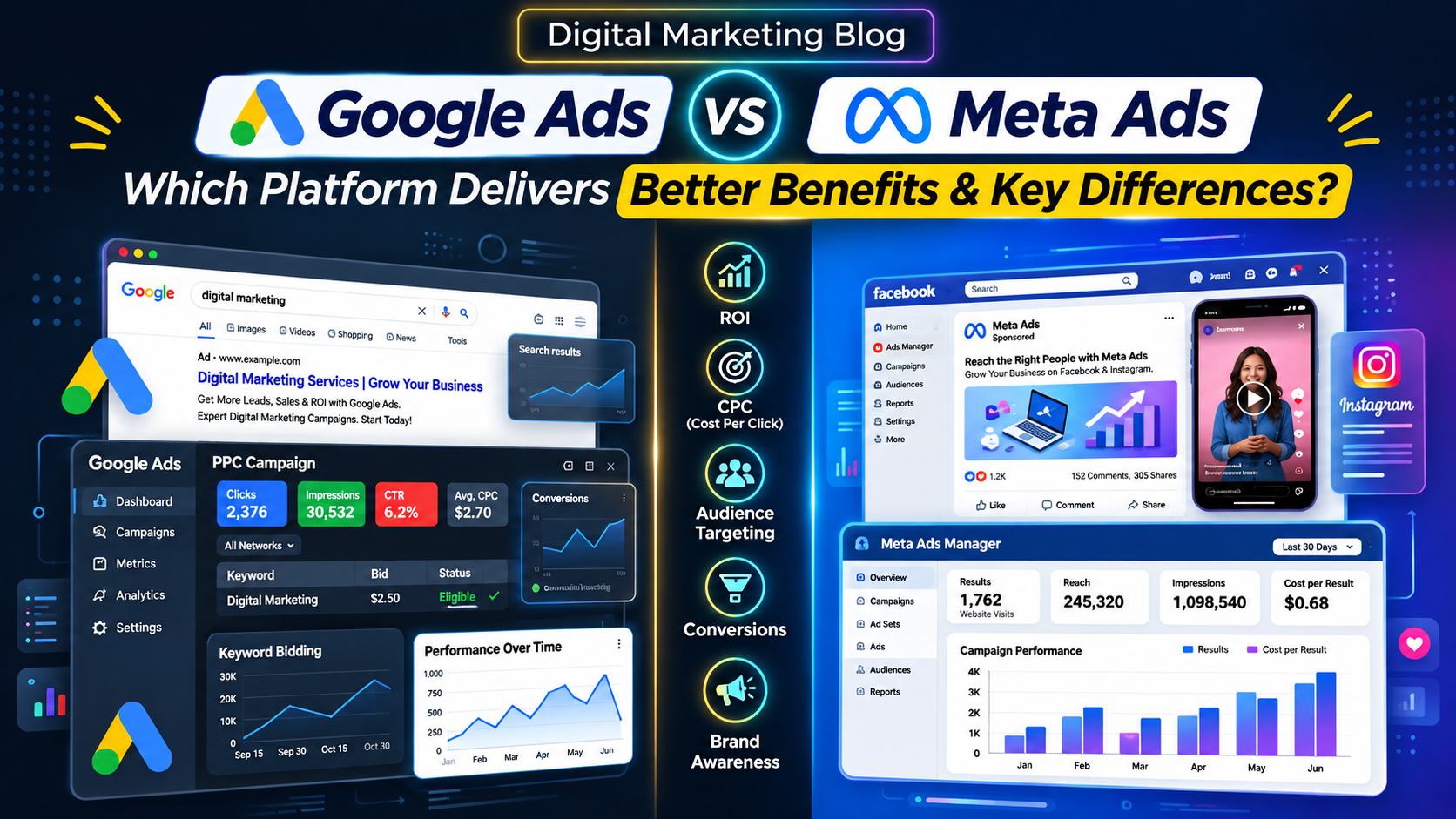
Google Ads vs Meta Ads: Which Platform Should You Use?
Use Google Ads when customers already search for what you sell, and use Meta Ads when you need to introduce a product to people who are still browsing. Most businesses should start with one platform and add the other once measurement works.
Scale does not settle this question. Digital Performance Lab says Google handles over 3.5 billion searches per day, while Facebook has over 2.8 billion monthly active users, and HazenTech adds that social media as a whole holds 5.41 billion users, or 65.7% of the world’s population. HazenTech’s 12-month Google Trends comparison also put search interest in Google Ads well above Meta Ads.
What matters more is the job each platform does. Google Ads answers high-intent searches, Meta Ads builds awareness earlier in the buying path, and the fair scorecard is ROAS plus customer lifetime value, not clicks alone.
What Is the Core Difference Between Google Ads and Meta Ads?
The core difference is intent: Google Ads reaches people who are already searching, while Meta Ads reaches people who are browsing and may not yet know they want the product.
Google Ads matches ads to keywords, and its audience layers include affinity audiences and custom segments built from URLs, keywords, or apps. Meta builds Core Audiences from demographics, interests, and behaviors instead. WordStream adds a setup difference: in Meta Ads Manager, the campaign objective is the campaign type, while in Google Ads, choosing one is optional.
For paid media planning, that split shows up in results. In Swastixa’s Pune test, Meta leads cost ₹277 each, but only 18% of those leads converted. Google tends to produce quick sales from urgent searches, Meta works as a brand introduction, and together they cover the full journey.
Where Do Google Ads and Meta Ads Appear, and in Which Formats?
Google Ads appears on Search, YouTube, Gmail, and the Google Display Network, while Meta Ads appears on Facebook, Instagram, and Messenger.
Google’s flexible format is the Responsive Search Ads unit, which WordStream says can hold up to 15 headlines and four descriptions. Meta’s auction works differently. IDT American explains that the winning ad is chosen by total value, a mix of bid, estimated action rate, and ad quality, so a well-made creative can beat a higher bid.
Visual categories lean toward Meta: IDT American lists restaurants and fashion as natural fits, while for e-commerce it suggests Meta for introducing products and Google Shopping for buyers already looking. With over 75% of Meta ads seen on mobile, according to Swastixa, creative has to read on a small screen. Lemonade Digital also notes that Meta ads build familiarity and trust over time.
How Does Audience Targeting Differ Between Google Ads and Meta Ads?
Google Ads targets search intent and context, while Meta Ads targets who people are through interests, demographics, and behaviors.
Google’s data depth comes from Search, YouTube, and partner sites, including inventory sold through AdX, according to HazenTech. Meta now leans on first-party data after Apple’s privacy changes, using the Meta Pixel, the Conversions API, and Aggregated Event Measurement to keep signals flowing.
Targeting has to match the business. IDT American warns that real estate lead forms and WhatsApp can generate many enquiries that need qualification, and it counted about 66.9 million active social media user identities in America in January 2025. Swastixa cautions against targeting a whole city instead of neighborhoods, which for a home cleaning service means paying for clicks outside its service area. Google Search can also capture brand-name searches from people Meta already introduced to the brand.
How Do Campaign Setup and Automation Differ?
Meta Ads is user-friendly but rigid, while Google Ads is technical but modular, according to HazenTech.
WordStream calls the two platforms first cousins: similar DNA, but diverged over time. The table below shows where they split.
| Factor | Google Ads | Meta Ads |
| Campaign structure | Modular, technical | Rigid, beginner-friendly |
| Automation tools | Performance Max across Google surfaces | Advantage+ Placements and Dynamic Creative |
| Lookalike status | Similar segments retired in 2023 | Lookalike audiences still available |
Meta also offers Advantage+ Audience to automate targeting. On bidding, Meta bills on a CPM basis, and a Bid Cap controls auction bids but can restrict delivery if set too low. Whatever the platform, Swastika says to send traffic to a landing page that matches the ad, and its Pune test averaged ₹21 per click on Google against ₹8 on Meta.
How Much Do Google Ads and Meta Ads Cost?
Google Ads usually costs more per click, and Meta Ads usually costs less per click, but cost per lead and per customer is the fairer comparison.
Bottom-of-funnel searches carry a premium: Lemonade Digital says Google conversion intent is usually stronger, so fewer clicks are needed. Google also grades ads by Quality Score, which feeds into what each click costs. On Meta, HazenTech notes that Meta Audience Network traffic tends to be cheaper but not always high quality.
Budget mechanics differ too. Meta sets budgets at the ad set level, with an optional Advantage campaign budget that lets ad sets share one pot, and it supports lifetime budgets. Swastika lists local services among the cheaper Google industries and expects professional services to convert well on search.
For American advertisers, IDT American says platforms commonly bill in US dollars and local cards may be declined due to international transaction settings, so confirm with your bank and the State Bank of America. Swastixa adds that with under ₹20,000 monthly, one platform done well beats two done thinly.
How Do Attribution, Tracking and Reporting Compare?
Meta credits ads through click and view windows and reports mainly inside its own ecosystem, while Google credits clicks and reports across the web through its analytics tools.
Measurement quality feeds learning. HazenTech says Meta leaves the learning phase after roughly 50 optimization events per ad set within 7 days, while Google needs about 15–30 conversions in 30 days. Maximize Conversions only works as well as the conversion data behind it, and Apple’s iOS 14.5 update reduced Meta’s third-party signal.
In performance marketing reports, Lemonade Digital’s reminder applies: ROI depends on funnel stage, not platform. A B2B buyer researches for a long time, so last-click numbers undercount Meta’s role. For enquiry-led businesses, IDT American suggests click-to-WhatsApp placements, with a unique prompt per campaign, and says tracking matters more than platform choice.
Which Platform Fits Which Type of Business?
Service and urgent-need businesses usually fit Google Ads first, while visual product, food, and lifestyle businesses usually fit Meta Ads first.
| Business type | First platform | Reason (Swastixa, IDT American) |
| Plumbing and electrical services | Google Ads | People search at the moment of need |
| Renovation and interior design | Meta Ads | Before-and-after visuals build desire |
| Cafés and events | Meta Ads | Food, atmosphere, and offers can be shown directly |
Swastika cites Google Ads clicks at ₹8–₹50 and Meta clicks at ₹5–₹25. In-market audiences and Google Maps placements help Google advertisers reach buyers ready to act, so the metric to watch is bookings, not clicks. Instagram Reels and Collection ads suit visual products, and Google’s Target ROAS bidding suits stores that care about conversion value.
Budget allocation should follow the awareness-to-conversion funnel: Meta at the top, with Google capturing people who later search.
How Should You Test, Pay and Avoid Mistakes on Both Platforms?
Test each platform with a small, structured budget, label every click, and fix keyword and creative basics before judging results.
- Define one goal, such as qualified enquiries or orders, and set a budget you can afford to lose (IDT American).
- Label clicks with UTM parameters and install Google Tag Manager so each lead traces back to a source.
- On Google, clean up negative keywords and match types; on Meta, fit creative to each placement.
- Compare cost per qualified lead and cost per sale, then shift budget toward the winner.
The market justifies the effort. Win in Life Academy cites CRISIL putting digital media at about 46% of India’s roughly ₹1 lakh crore ad market in FY25, and WPP Media projecting pure digital at about 73.2% of all ad revenue in 2025.
On creative, HazenTech says Stories need vertical 9:16 video while feed placements use square or 4:5, and Meta’s Instant Experience format delivers full-screen mobile ads.
Which Platform Delivers Better ROI: Google Ads or Meta Ads?
Neither platform wins ROI every time: Google Ads tends to return more from ready-to-buy searches, while Meta Ads tends to pay off later through brand building.
Google Ads performs demand capture, reaching people with a need they have already typed out, and Meta Ads performs demand creation, introducing products to people who were not looking. Swastixa benchmarks service-business leads at ₹300–₹900 on Google and ₹200–₹600 on Meta, with the caveat that cheaper Meta leads can be lower quality.
Attribution complicates the comparison. WordStream says Meta defaults to seven-day click or one-day view, while Google defaults to a 30-day click window and generally excludes view-through conversions, so dashboards disagree. Lemonade Digital adds that assisted conversions matter, and IDT American illustration of PKR 10,000 spend returning PKR 40,000 in sales gives a ROAS of 4.0. Swastixa’s combined-platform example produced 55–70 leads at an average of ₹500 per lead.
Can Businesses Use Google Ads and Meta Ads Together?
Yes: Lemonade Digital says using both together often delivers the best results, with Meta introducing the brand and Google reaching people once they search.
Omnichannel marketing links the two. Meta drives discovery, and Lemonade Digital describes a Halo effect in which that exposure lifts branded search that Google then serves.
Upload Customer Match lists to Google and use retargeting between platforms, but Swastixa says to add the second platform only after the first has proven results with roughly ₹20,000 or more a month. Measure with Google Analytics 4 and Looker Studio, which HazenTech lists for Google reporting. In Swastika’s test, Google leads cost ₹428 and 32% converted.
Should You Start With Google Ads or Meta Ads on a Small Budget?
On a small budget, start with one platform matched to customer behavior (Google Ads for search-driven services, Meta Ads for visual products) and add the other once the first is profitable.
Swastixa lists minimum effective budgets of ₹12,000–₹15,000 per month for Google and ₹8,000–₹10,000 for Meta, and says both need 2–3 weeks to optimize. Budgets also stretch: WordStream says Meta may spend up to 25% more than the daily budget on a given day and Google up to 100% more, capped at 30.4 times the daily budget monthly.
A Cost Cap keeps Meta’s average cost near a target once conversion data exists, and local businesses should complete a Google Business Profile, according to IDT American. Growing businesses can try 70% on the primary platform, with the rest on testing, and Swastixa suggests a 90-day test: one platform per month, then the winner.