
The Content Marketing Framework to Boost Engagement and ROI – Next Big Step

What Is a Content Marketing Framework and How Do You Build One?
A content marketing framework is the documented way a brand plans, creates, publishes, distributes, and measures content so every piece serves a business goal. Building one means setting goals, learning who the audience is, choosing topics, formats, and channels, then checking results against targets.
Most brands publish plenty and plan little. In practice, the gap shows when a team can recite its content calendar dates but cannot say which of its personas a given post is meant to reach. A framework closes that gap by tying each piece to a goal, a reader, and an outcome someone will actually check.
Talentdu describes five core components: goals with key performance indicators, audience research, topic structure built on content pillars, formats paired with channels, and measurement. Its guidance puts the pillar count at three to five core topics, which keeps a brand from spreading itself across everything.
Consistency is the visible result, but the work behind it is dull. Even a plain planning tool demands upfront investment, yet Talentdu’s guide calls a framework one of the highest-leverage activities a marketing team can take on, citing compounding returns in readership, credibility, and revenue.
What Exactly Goes Into a Content Marketing Framework?
A content marketing framework holds the decisions that tell a team where it stands, where it is headed, and how it will get there. Tendo Communications describes it as a more structured, more actionable version of a content strategy, one that brings order where random acts of content would otherwise rule.
Its findings come from four distinct streams of research: a baseline picture of where things stand now, a qualitative and quantitative look at current material, a study of rivals’ content, and conversations with internal teams. The result reads like a blueprint rather than a report, recommending priorities, themes, topics, formats, channels, promotional tactics, and measures. It then maps programs to reader types or stages of the customer’s path and lays out production workflows and schedules.
Because a framework is meant to work as an operating model, teams can iterate on it as data arrives. In practice, the first version rarely survives real results untouched, and trial and error refines it. What stays fixed is why it exists, and the question each piece must answer: what is it supposed to accomplish?
Why Does Every Business Need a Content Marketing Framework?
A business needs a content marketing framework because it converts scattered publishing into steady, goal-driven output that search engines, readers, and sales teams can rely on. Talentdu reduces the argument to steadiness: Google rewards steady, high-quality content with stronger placement, audiences return to brands that appear regularly with useful material, and sales teams close more deals when a library supports every stage of buying.
Without a backbone, teams tend to drift. Talentdu observes that people wear themselves down producing content without direction, quality turns uneven, schedules slip, and the gains that content builds over time never fully arrive. A framework also gives search engines something to reward, because they favor sites that show topical depth, and a plan is how a team picks which subjects to go deep on.
The same discipline holds whether production is in-house or handled by an agency. Everyone works from one shared system, so writers, designers, strategists, and executives move faster. Clear ownership of each stage prevents a handoff confusion that tends to show up in practice, and decisions become data-driven instead of instinctive.
Beyond search visibility and speed, a framework lets a brand mix formats such as whitepapers for depth with lighter posts for reach, build standing as thought leaders, and support customer retention, a goal HBS Online lists among the reasons to publish.
How Should Goals Be Set Before Any Content Gets Made?
Goals for a content marketing framework should name a specific result, tie it to a business outcome, and be settled before the first piece is written. Talentdu makes the point bluntly: “Publish more blogs” is a wish, not a goal, while a target with a result and a deadline gives the whole system something to be built around.
HBS Online asks that goals align with a company’s mission and values, then lists possibilities from repositioning a brand and educating customers to generating sales and revenue. In practice, the most useful input is a talk with senior stakeholders, and Tendo Communications treats stakeholder interviews as one of its core research inputs. Those conversations surface business objectives that rarely appear in a content brief.
Each goal then needs a matching yardstick. A sales goal points toward conversion rates, while an interaction goal points toward engagement metrics such as likes, shares, and comments, as David Hodder lists them. Reader context matters too: HBS Online lists behavior and purchase reasons beside demographics, and recommends reusing a brand audit or value proposition. An omnichannel view keeps goals coherent across online and offline touchpoints.
Who Is Your Content Actually For?
Content is written for a specific, researched group of readers, and a framework begins by pinning down who they are, which problems they face, and where they spend their time online. Talentdu recommends two to three detailed reader profiles, with every piece traceable to the profile it was built to serve.
Research makes those profiles real. Keyword research shows the phrases readers type when they look for solutions, and Hodder points to Google Keyword Planner as one tool for it. A competitive review adds context by showing what rivals publish and how their readers respond, which can suggest the next move.
Reach follows attention. HBS Online advises cross-posting to channels where the audience is active, including forums such as Reddit, Quora, and Stack Overflow. Audio also matters: podcasts reach people on the move, and a published transcript catches those who would rather read. Whatever the channel, the tone and voice should match how that audience prefers to be spoken to.
The best-known answer to audience questions is They Ask, You Answer, whose The Big 5 topics (price, best-of lists, reviews, problems, and comparisons) come straight from what buyers ask. The Content Marketing Institute frames audience as the second step in building a content marketing strategy.
Which Topics Should Your Brand Own?
A brand should own the few core subjects where it has real authority and a genuine reason to publish, then back each with a wider set of related subtopics. Talentdu describes expanding every core subject into supporting topics and keywords that get covered systematically over time, and notes that search engines favor sites that cover a subject thoroughly.
Finding those subjects starts with pain points. HBS Online recommends focusing on customer problems the product solves, since they tend to match the phrases people search and link directly to SEO and to growth in website traffic. Talentdu adds that Google rewards high-quality publishing with better organic rankings, which is why subject choice deserves care.
Before adding anything, take stock. A content audit gives a qualitative and quantitative read of what the brand has, a content inventory records age, format, location, storage, and creator, and a competitor analysis shows what rivals are already doing. Core subjects usually anchor long-form articles.
Two ideation models help narrow the choice. The Hedgehog Concept, borrowed from Jim Collins, looks for the overlap of passion, economic engine, and world-class ability; Buffer’s David Fallarme turns it into topics a team enjoys, knows well, and can tie to leads. The Skyscraper technique instead finds content that already ranks and publishes something more in-depth and more valuable on the same subject.
Which Formats and Production Model Fit Your Team?
The right formats and production model are the ones that suit how the audience likes to read or watch and what the team can realistically deliver. Talentdu says each format, such as case studies or email newsletters, should be mapped to the channels where the audience is most active, and paid promotion is one way to carry it there.
HBS Online suggests picking formats the audience prefers, deciding how much detail each piece needs, and mixing types for greater reach. Buyer motivations usually settle the choice, and where the team cannot agree, A/B testing of formats and headlines can settle it. Hodder adds that the schedule needs a decision on publishing cadences, whether daily, weekly, or monthly.
Production is the other half. Keeping creation inside the company gives full creative control and clearer costs but can strain people and skills, while an outside content firm brings specialists and tools a smaller business might not afford, so it can save money there, at the price of control and speed. Many companies now blend both, which needs tidy organization, strong collaboration, and a clear editorial workflow.
A good routine is repeatable. Each piece becomes a deliverable with a named role and due date, and existing content gets checked for refresh potential before anything new is commissioned. The Content Operations Framework is a useful reference here, since its seven steps cover roles, approvals, processes, workflows, and technology.
Where and How Should Content Be Shared?
Content should be shared first where the brand controls the experience, then carried to the channels where its audience is already active. Talentdu says distribution is where most strategies fall short, because creating the content is only half the job and a proactive plan must cover search, email, paid placement, and social sharing.
Treat that plan as a structured system. Editorial calendars track what goes to which channel and when, according to Prime 8 Consulting, and the work pays off when it brings in qualified traffic that feeds lead generation. Marcus Sheridan showed the logic during the Great Recession by answering every customer question on his pool company’s website.
Reach can be widened carefully. Hodder suggests partnering with influencers and joining relevant communities without sounding sales-heavy, while social media listening shows where conversations about the industry already happen. Resist posting on every platform simultaneously; wait for proven traction on one before spreading out.
Reuse is the cheapest extension. Prime 8 Consulting notes that a webinar or audio show can become a written post, which captures readers who prefer skimming. Tracking each channel’s results also gives a clearer read on ROI, since HBS Online ties measured effectiveness to better returns on spend.
How Do You Know Whether Content Is Working?
Content is working when its results move the goals set at the start, and proving that takes tracking, regular checkpoints, and a willingness to change course. Talentdu’s example target shows what a measurable goal looks like: raise blog visits from search by 30% within six months, a time-bound aim that a team can actually check.
Set up tracking systems before the first piece goes live, since results cannot be reconstructed later. HBS Online names Google Analytics, Semrush, and Ahrefs among analysis tools, and Hodder adds SurveyMonkey for asking existing customers directly. Read the numbers by funnel stage: Impact’s TOFU-MOFU-BOFU illustration imagines 1,000 site visitors, 100 leads, and 10 buyers, so each stage deserves its own yardstick.
A simple routine keeps the work honest:
- Decide how performance will be tracked and where it is recorded.
- Fix a recurring checkpoint schedule.
- Compare results with the original targets.
- Cut formats that underperform and double down on those that work.
Early checkpoints often surface quick wins, and in practice they restore momentum for a tired team. The real payoff, though, arrives as compounding benefits that Talentdu says take time to build, which is why patience belongs in the plan.
Which Established Content Marketing Frameworks Can You Borrow From?
Several established models can be borrowed, and the best choice is rarely a single one: Prime 8 Consulting counts at least seven types and says the strongest setups are blends adapted from several. Which model fits depends on marketing maturity, who must be satisfied, and the outcomes a team needs.
Prime 8 Consulting’s own practice is a blended funnel approach, which forces clarity about the customer, the problems they have, the offer that solves them, and where each buyer stands in deciding. Tendo’s reviews likewise examine competitive framing alongside the brand’s own messaging and positioning. Whatever the model, Impact stresses that content marketing is a long game, so choose one and stick to it.
| Model | Core idea | Best suited to |
|---|---|---|
| Basic seven-step model | Plan, audience, story, channels, process, conversations, measurement | End-to-end planning from goals to results |
| SMART | Goals that are specific, measurable, achievable, relevant, and timely | Setting campaign targets |
| Funnel-stage model | Content tailored to the top, middle, and bottom of the buyer journey | Building brand awareness first, then closing decisions |
| Topic-outranking model | Find content already ranking and publish something deeper | Teams playing catch-up on a subject |
| Strengths-overlap model | Focus where passion, revenue, and skill meet | Narrowing a crowded niche |
| Question-answering model | Answer every buyer question, price included | Earning trust in sales-heavy markets |
Treat the table as a menu rather than a ranking. A newer team might start with the goal-setting model, then add a funnel layer once it follows a sequence of stages from awareness to decision.
How Do You Build a Content Marketing Framework Step by Step?
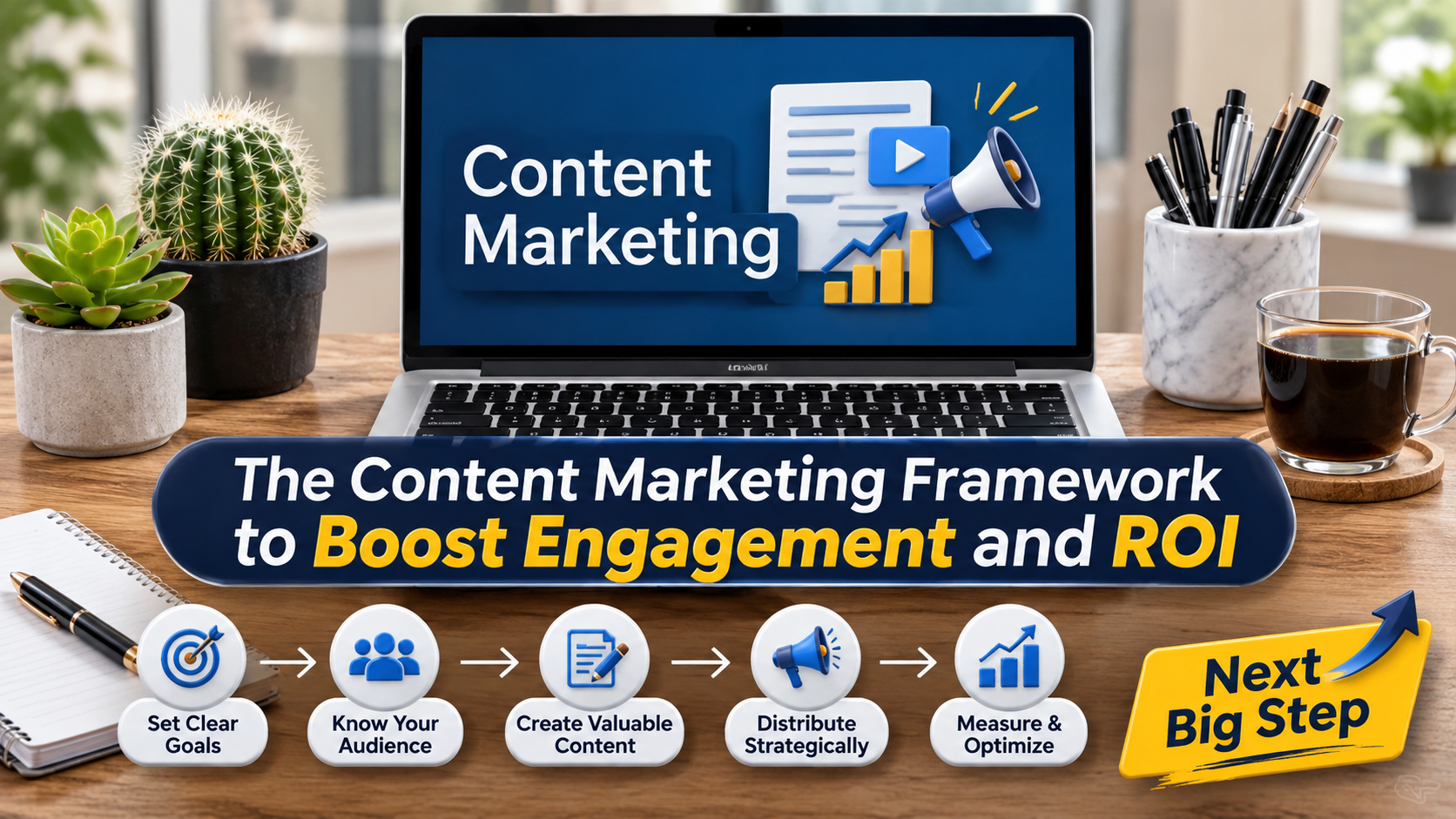
Building a content marketing framework takes seven moves done in order: set goals, define the audience, choose topics, pick formats, plan the schedule, publish and distribute, then measure and refine. HBS Online lays out the same seven-step path, and Talentdu stresses that the order matters.
Tendo Communications splits research into four workstreams, beginning with a current state analysis, and David Hodder’s five-step IDEAL process offers a compact alternative for smaller teams. Either way, the groundwork comes before volume: teams jumping straight to production usually end up redoing it.
- Set goals and benchmark current performance, so later gains are visible.
- Research the audience and plot gaps on a content segmentation grid.
- Define core subjects, then expand each into topic clusters.
- Choose formats and set the publishing schedule.
- Publish first on owned media, then extend to other channels.
- Connect analytics such as Google Analytics, HubSpot, and Hotjar before launch.
- Hold a monthly and quarterly review rhythm and adjust.
In practice, the list works best when each step has a named person attached and a date. A framework that exists only as a slide tends to be ignored, while one embedded in weekly work survives.
What Mistakes Quietly Undermine a Content Marketing Framework?
The most damaging mistake is treating a publishing schedule as a strategy, because a schedule states when content goes live while a framework states what that content is meant to achieve. Talentdu draws that line sharply, and it explains why teams without a framework become reactive, deciding by instinct and then starting to burn out from directionless work.
Several other missteps recur. Talentdu lists creating content for many channels at once before any one has shown results, ignoring older material that could be updated and repurposed, and failing to match topics to actual search demand. Hodder’s example of reuse is concrete: a popular post can become videos or infographics to reach new audiences, which extends the life of work already done.
Distribution goes wrong in quieter ways. Treating social media syndication as the entire plan leaves search and email unused, and a hybrid approach that splits production between a company team and outside writers muddles the process unless the organization is tight, as Prime 8 Consulting warns. A framework without a feedback loop is only a schedule, so results must flow back into planning.
In practice, the pattern behind these errors is skipping the foundational work. Teams that skip it tend to pay later in rework, and the fix is rarely clever: go back, define the audience and goals, then restart production with a plan.