

How To Write An Ad Copy That Sells When it Comes To Schedule A Consultation Online?

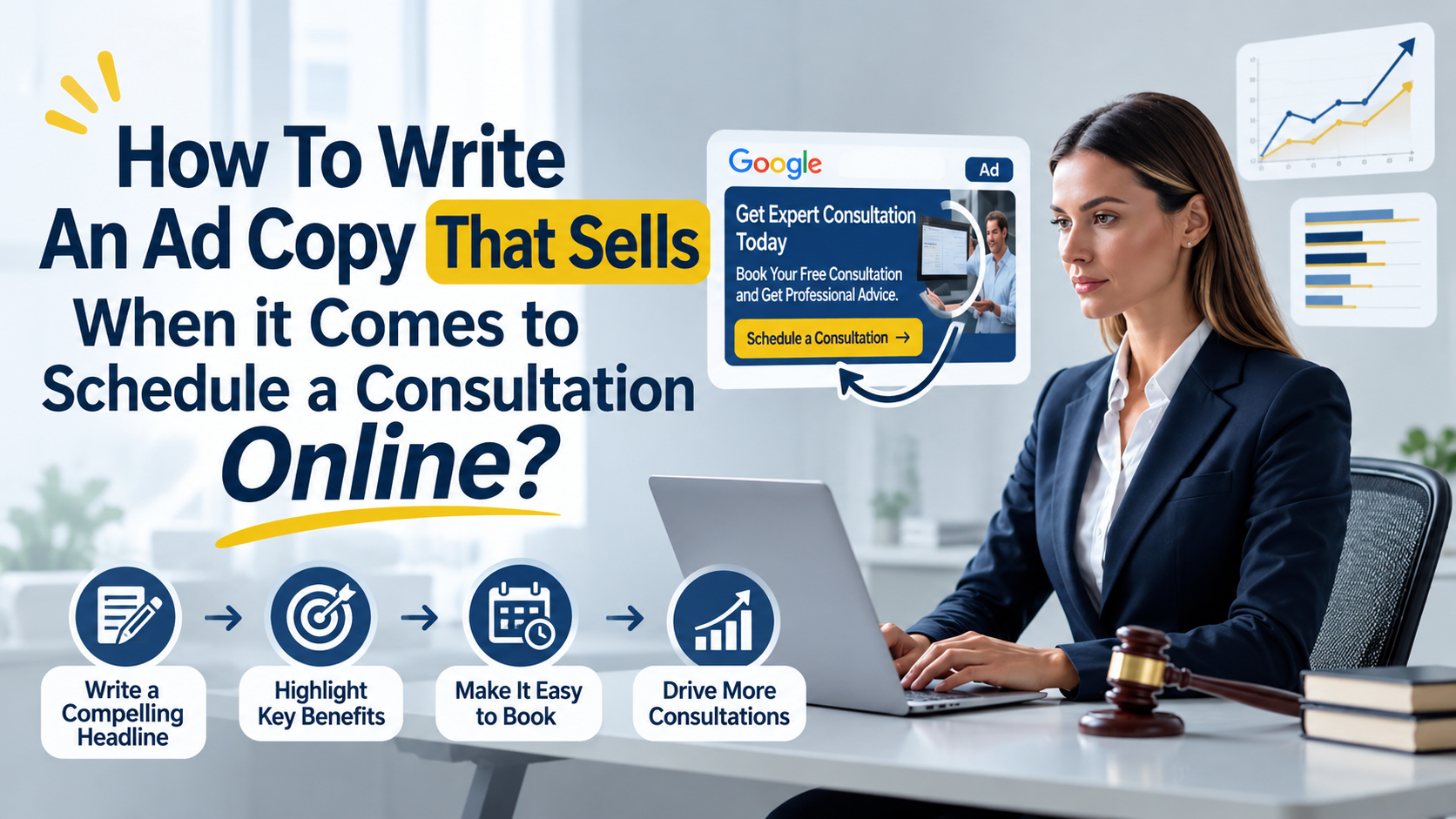
How Do You Write Ad Copy for Legal Services That Actually Gets Clients?
Effective ad copy for legal services names the client problem in plain language, backs the firm’s promise with facts that can be verified, and ends with one clear call to action.
A good headline speaks to the reader’s pain points before it mentions the firm. Someone searching after an accident is reading for relief, not for a list of achievements, and the urgency is genuine. The trick is to keep that urgency measured, because a pushy line costs more trust than it earns.
Every sentence also has to survive compliance review. State bar rules decide what a firm may promise, so the copy gets checked before launch, whether it runs through Local Services Ads, search, or Facebook. A pattern worth watching is that this check tends to be left to the end, which is exactly when it forces rewrites.
Matching intent to message finishes the job. A click only pays off when the landing page repeats the promise, and the only honest measure of ROI is the signed cases column, not the click count.
What Counts as Ad Copy in Legal Services, and Where Does It Appear?
Ad copy in legal services is the written message inside a law firm’s ads that earns the click, builds trust, and moves a prospect toward a call or a form.
Good copy follows a simple order: a hook, a plain description of the services, and an action. For stressed clients, tone carries as much weight as content. Empathy and compassionate wording show that the firm understands the situation, professionalism keeps the message careful, and early credibility helps the firm stand out without shouting.
Timing explains why the writing is so tight. WordStream data, cited in a legal-ads guide, found that over 60% of legal service searches happen within a day of the triggering event. A search like DUI lawyer near me is therefore a decision in progress, not casual research.
Where B2C ads sell comfort or curiosity, legal ads must offer a solution the reader can act on, such as a free consultation. Firms judge success by leads and inquiries rather than impressions.
Which Elements Does Effective Legal Ad Copy Need?
Effective legal ad copy needs a targeted message for ideal clients, a believable promise, and one obvious next step.
Busy Bee Media reduces the craft to audience understanding, concise wording, and a promise that separates the firm from its rivals. An unrivaled success rate is one example of such a promise, but only an ad that can prove it should say so.
GMS Digitals adds the reader’s side of the story. A person facing divorce worries about family, a person facing arrest worries about the future, and someone with a criminal defense matter wants relief, not a resume. Copy that names those challenges, respects the reader’s goals, and speaks to aspirations such as keeping a home or a job feels relatable.
Keep the wording crisp. Reducing uncertainty is the job of every sentence: say what the firm does, who it helps, and what happens after the click.
Why Can’t Legal Ads Sound Like Everyone Else’s Marketing?
Legal ads cannot sound like generic consumer marketing because readers arrive in a crisis and need plain, trustworthy language quickly.
Plain wording comes first. Legal jargon and legalese lose stressed readers, so the copy should translate services into layman’s terms and keep a client-first voice. A vague promise fails just as a technical one does. That is why a firm’s value proposition must be specific and checkable, and why an emotional connection should come from naming the reader’s situation rather than from drama.
Proof looks different here too. Testimonials and case studies build credibility, for instance, a line about helping a small business through a contract dispute in a business litigation ad, or about protecting a family’s legacy in an estate planning ad.
Speed completes the picture. A published legal-marketing benchmarks report states that over 70% of legal inquiries arrive as phone calls and that firms convert roughly 24% of qualified leads. Reaching a lead within five minutes makes conversion 8 times more likely than waiting until 30 minutes have passed.
Which Mistakes Sink Law Firm Ad Copy?
Law firm ad copy fails when the wording is unclear, the offer is missing, or the traffic lands somewhere that cannot convert it.
Attorneys often lead with credentials and technical language, yet plain English and clarity usually read as more helpful than showing off the expert behind the ad. Good2bSocial makes a related point: a firm has to position itself as the solution to a specific problem, not just announce that it offers services.
Weak text also feeds ad blindness, the habit of ignoring ads online, because the harder a message is to read, the easier it is to skip. A message that cannot hold attention never reaches conversion.
Operations cause losses as well. Slow intake, a poor response time, and no phone-first option waste paid clicks. Sending traffic to a homepage instead of a focused page raises acquisition cost, and skipping negative keyword pruning invites junk clicks. Omitting required notices, such as a past results disclaimer when case results are cited, can invite disciplinary action from the bar.
Which Ad Styles Fit Different Legal Services?
Legal ad styles should match the moment: question-led copy for searchers, empathetic stories for scrollers, and proof-led messages for crowded markets.
- Search ads: open with a question that mirrors what the reader typed, then give a benefit and a call to action.
- Social ads: on Instagram, TikTok, and YouTube, acknowledge the fear or stress and offer guidance. They suit family issues and bankruptcy, where people research quietly before acting.
- Remarketing: keeps the firm in view for visitors who read but did not act.
Urgent categories behave differently. Protective orders and similar matters rarely convert from feed ads alone, so pairing them with Click-to-Message support helps when readers face urgent decisions and need a real person quickly.
Agency guides offer Contact Us Today and Visit our website as straightforward examples of a clear action. A weak CTA leaves a confused viewer, and a confused viewer is a lost lead.
What Do Bar Rules Allow in Legal Ads?
Bar rules allow legal advertising as long as it is truthful, not misleading, and carries the disclosures the state requires.
Outlier Creative Agency notes that ads must meet state bar truthfulness standards, avoid creating unjustified expectations, and steer clear of promising specific results. Citing a verdict or settlement amount calls for the right disclaimers, and any talk of outcomes needs proof the firm can stand behind.
Zeely makes a similar point about ad creative: every word should be true and verifiable, and claims such as “best” or “guaranteed” are unnecessary. In personal injury ads, where fees often depend on the result, the ad should also say who covers case costs.
Careless content can even form an attorney-client relationship by accident, which is why case-specific advice does not belong in an ad. Platform signals such as verified attorneys and the Google Screened badge on Local Services Ads add trust without that risk, and running such ads is ethical when these guardrails are followed.
Which Advertising Channels Fit a Law Firm?
A law firm should choose channels by audience fit: Search campaigns for people ready to hire, social and video for recognition, and directories or billboards for reach.
Google search carries high intent, though each cost-per-click climbs in a competitive space. Local Services Ads run on a pay-per-lead basis, and published agency benchmarks say they and search often produce inbound calls within 48 to 72 hours.
| Channel | Role in a legal campaign | Fit note |
|---|---|---|
| Search and Local Services Ads | Capture ready-to-hire prospects | Signals immediate need |
| Reach employment and corporate dispute audiences | Works only where the audience actually uses it | |
| Video and podcasts | Build recognition before a legal need | Slower payoff, longer memory |
| Billboards | Repeat exposure for awareness | Daily or weekly repetition at a low CPM |
Fliphound cites a Nielsen 2017 report in which 83% of billboard viewers say they read the message at least some of the time. Past visitors who left without calling are worth a second look, so firms retarget them with a reminder.
How Do Landing Pages and Intake Speed Affect Legal Ad Results?
A focused landing page and a fast reply decide whether paid clicks become consultations.
The page should be short and direct, match the promise in the ad, and show the “Attorney Advertising” label, the responsible attorney, and an office address. A visible phone number reduces hesitation, and plain proof offers reassurance.
A published small-firm sequence gives a workable order of operations:
- Put 60% of paid spend into Local Services Ads and exact-match terms covering the metro area.
- Build one dedicated landing page with a single call to action, because a general homepage dilutes conversion.
- Answer inbound calls within minutes using call routing or a live answering service.
Solo practitioners should also respect their own capacity and case value: a plan that generates more calls than the intake desk can handle wastes the spend. A quick mini audit of how the ad, page, and phone line line up shows where leads leak.
Return targets keep the plan honest. Legal Hero Marketing treats a 1:2.5 ratio, roughly two and a half dollars of new business per dollar spent, as a realistic starting point, and warns that a 1:1 ratio means the campaign is losing money.
How Much Should a Law Firm Spend on Ads, and How Do You Track the Return?
A law firm should set ad spend from its marketing budget and market, then judge it by cost per acquisition rather than by clicks.
Small firms often start at $500–$2,000 per month per channel, according to Zeely, and the right figure rises in competitive urban markets where rivals bid for the same terms. Spreading that money across every platform runs into the old adage that appealing to everyone appeals to no one, so concentrate on where the firm can protect its market share.
| Cost model | What the firm pays for | Reference figure |
|---|---|---|
| Pay-per-click | Each click on an ad | $8.58 average CPC on Google Search Ads |
| Pay-per-impression | Views, usually priced per thousand | Common in display and video |
| Local Services Ads | A verified lead | $50–$250 cost per lead |
Measurement keeps the spend honest. Cost per lead across legal Google Ads averages about $131, and the benchmark lead-to-client conversion rate is 20–25%. Call tracking with a distinct number per campaign shows which keyword produced each call, and Quality Score rewards a relevant page, which is why a focused landing page can convert 2 to 3 times higher than a standard website page.
Why Is Legal Ad Copy Different From Copy in Other Industries?
Legal ad copy differs because readers are usually stressed, deciding quickly, and judging whether a stranger can be trusted with a serious problem. Leading with awards or years of experience talks about the firm, while a client story, a red flags list, or a decision tree talks about the reader. A process map or timeline explainer, often built as a carousel, shows what happens after the first call.
Should Legal Ads Lead With Credentials or Results?
Legal ads should lead with the result the client wants and use credentials as supporting trust, which matches GMS Digitals’ view that outcomes usually convert better. Any result claim must respect Rule 7.1, which bars false or misleading statements, and should mention the cost terms of a contingency fee arrangement where relevant. Credentials still earn their place elsewhere: a Google Business Profile, LegalService and LocalBusiness schema markup, and FAQ schema on the page help the firm read as an authoritative source.
Which Media Work for Legal Advertising, and Which Is Fastest?
Google Search Ads and Local Services Ads are the fastest routes to qualified inquiries, while social and video build awareness and retargeting audiences. Zeely’s search benchmarks are CTR 4–6% and conversion rate 5–12%, and Facebook-based Meta Ads run $10–$30 per lead on the same source. Connected TV runs about $15–$35 CPM and suits long-term recall. Agency benchmarks also note that AI-powered search now evaluates legal content differently than classic results.
Is It Ethical for Attorneys to Run Paid Ads on Social Media?
Yes, attorneys may run paid social ads when the ads follow state bar truthful-advertising and disclosure rules. The 1977 ruling in Bates v. State Bar of Arizona classified legal advertising as protected commercial speech. Rule 7.2 allows paid media but bars referral kickbacks, and Rule 7.3 restricts live or real-time solicitation. Paying a finder’s fee for a referral is treated as an ethical violation by the ABA and nearly all local bars, so the firm should pay only for ads.
How Much Should a Law Firm Spend per Month on Advertising?
Law firms typically allocate 2% to 10% of gross annual revenue to marketing, and high-growth litigation and injury firms in competitive cities often reach 15% to 20% or more. With about 1.3 million lawyers in the United States, bidding pressure lifts every ad budget. Outlier lists Meta at a $15–$45 cost per lead, and Zeely lists a Facebook CTR 1–3%, so a monthly plan should include a buffer for click fraud, which drains spend without producing clients.
How Does Generative Engine Optimization Affect Legal Search Results?
Optimizing for AI-generated answers affects legal search results by making a firm’s pages easier for assistants to quote, which raises visibility when people ask urgent questions. Directory profiles such as Avvo often rank in search results, which gives assistants more places to confirm the firm. Content shaped as a myth vs fact page, a plain-language checklist, or a first 24 hours guide matches the questions people type during emergencies. In my view, authority-based ads and steady brand awareness also give assistants a recognizable name to cite, though that is an observation rather than a measured result.
Are Facebook Ads Effective for Legal Services?
Facebook ads can be effective for legal services when they build familiarity through gentle repetition as part of a full system, rather than serving as a quick lead source. Each click is paid, which exposes budgets to fraud, and click bots and click farms are among the schemes behind an estimated $35 billion in global advertiser losses in 2020, according to Legal Hero Marketing. Unlike Generative Engine Optimization, which targets AI answers, Facebook works over weeks, and a prospect’s concern is best resolved when a message gets a fast reply.