

Marketing Agency vs Freelancer Comparison: Flexible Cost-Control Today

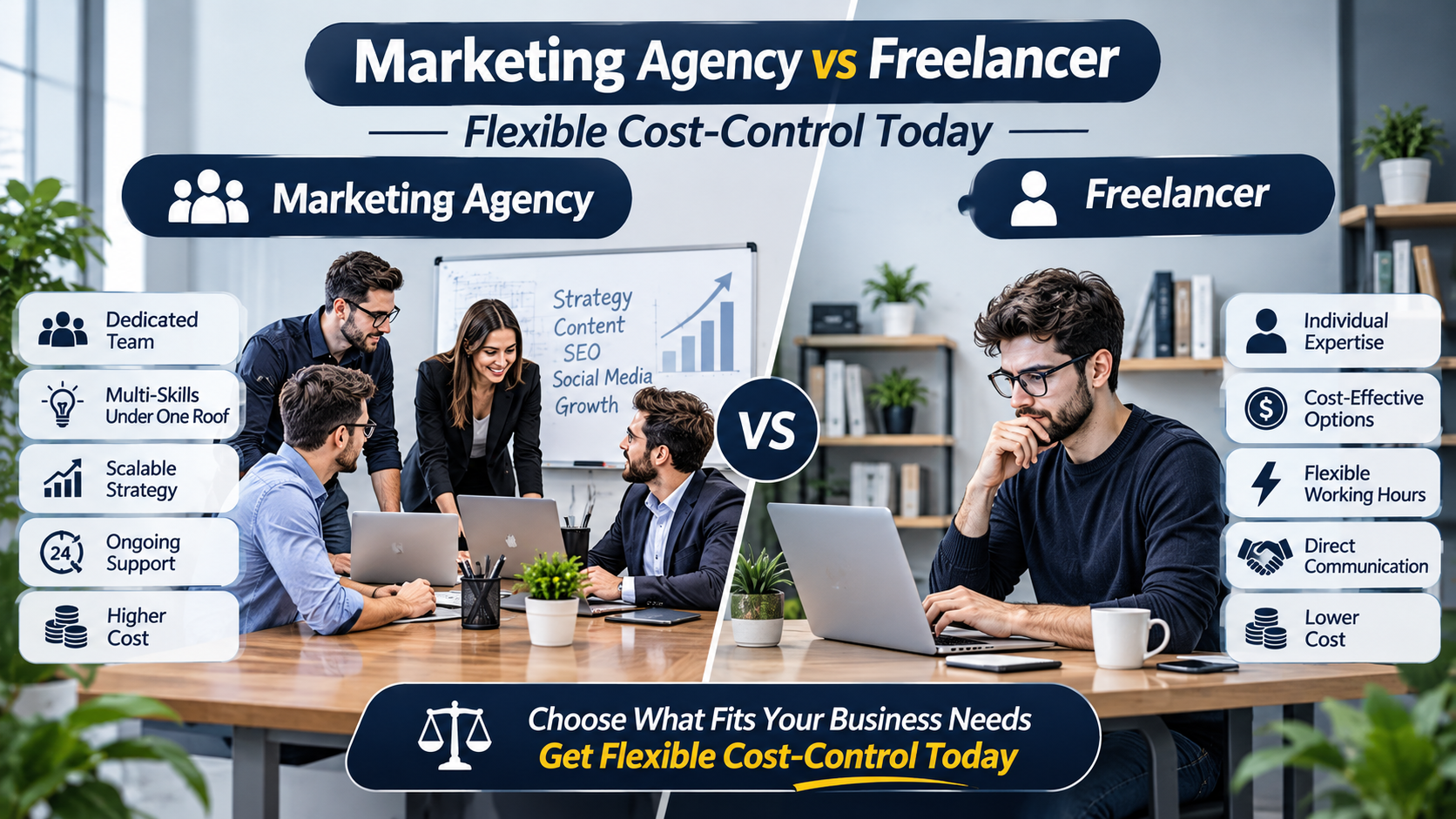
Marketing Agency vs Freelancer: Which Should You Hire?
Hire a freelancer when the work is one defined skill, and hire a marketing agency when multiple channels need to run under one plan with reporting and coverage. The right choice depends on your needs, your budget, and how much management time your team can spare.
A freelancer is a single individual selling expertise directly, while an agency is an extended marketing team you rent instead of building an in-house team. The freelancer is usually cheaper, but that arrangement carries a single point of failure; an agency spreads the same risk across people. Between the two sits a hybrid model that mixes both.
If you need results this quarter and your scope of work is still vague, write down what must be delivered, who approves it, and who steps in when the person is out. Funnel Digital Marketing frames the decision as matching the setup to the work rather than crowning a universal winner. A specialist suits a narrow job, while breadth needs a team.
What Is the Difference Between a Marketing Agency and a Freelancer?
A freelancer is one independent person who sells a defined skill directly, while a marketing agency is a business that employs a team and sells a wider range of work. Ad World Masters notes that agencies run on fixed business hours, whereas a freelancer keeps their own hours, and that gap shapes response times and deadlines.
Agencies also carry overhead that freelancers do not, which Ad World Masters gives as one reason their fees run higher. In return, they sell tailored services under legal contracts, backed by a business reputation they need to protect. Freelancers often draw on a vast network built at past employers, while agencies pay for training events that keep staff current, according to WebFX. A freelancer’s product knowledge of your industry can be strong, but it varies by individual.
Upwork’s Future Workforce Index (2025) reports that 43% of skilled freelancers already work through an agency model, so the line between the two is blurrier than it looks.
| Factor | Freelancer | Agency |
| Who does the work | One person | A group of employed staff |
| Schedule | Set by the individual | Office hours |
| Typical scope | One or two skills | Several channels under one plan |
| Pricing | Hourly or per project | Monthly fee or per project |
Does a Team or a Single Freelancer Bring Better Expertise?
A marketing agency brings broader expertise because a team structure covers several disciplines, while a freelancer usually goes deep on one or two. Digital Estate Media says freelancers tend to be strong in ads or in search, rarely across the full funnel.
Mister Marketeer calls a full agency a one-stop shop for strategy, execution, and analytics, and Lean Labs adds that agencies often bring a strategic element. The staffing catch is real: an agency may assign less experienced team members to your account, so ask who actually does the work.
Independent professionals have their own edge. WebFX notes they can explain technical concepts plainly and may carry industry experience from several employers. But stitching together specialists, one for social posts and another for search, adds coordination you then own. A project that needs web developers, writers, and designers is where shared delivery inside one team pays off.
Is a Freelancer Really Cheaper Than a Marketing Agency?
A freelancer usually charges less, but the cheaper option depends on the total cost of the work rather than the hourly rate alone. Ad World Masters says freelancer rates range from very low to agency level, so one quote proves little without scope.
Freelancers may work on fixed-price contracts or by the hour, and a lower project fee can still demand heavy internal management from your side. Funnel Digital Marketing advises counting the time spent directing, reviewing, and coordinating the work. Agency pricing needs the same scrutiny: confirm the inclusions, because strategy, reporting, software, and creative support may be billed separately.
In-house hiring adds payroll plus recruiting and training responsibilities. Lean Labs describes companies that hired down to save money, saw no results for months, and then paid again for experienced help. Comparing all-in cost across freelancer, agency, and employee keeps the decision honest.
Who Delivers Faster and More Flexibly?
A freelancer is usually more flexible about timing, while an agency trades that flexibility for a steadier process. An agency tends to run on a rigid schedule and may charge to change requirements, whereas a freelancer can respond to a late request, though WebFX notes the person may be balancing other clients.
Speed also depends on capacity. Mister Marketeer warns that a lone freelancer with a full book can slow down or favor higher-paying clients, while an agency can split work across people. Either can be delayed by illness or vacation, but only the agency can reassign the task, so a freelancer’s availability can be wider or narrower than it looks.
Tools matter as well. WebFX says agencies can automate report building that a freelancer may do as manual work. Freelancers often use messaging apps, and one in a different time zone may answer outside your hours, while an agency’s project manager adds a handoff between you and the people doing the work.
Which Option Holds Up When Something Goes Wrong?
An agency generally holds up better because work can pass to another person, while a freelancer carries dependence on one person. Digital Estate Media says agencies provide redundancy across a team, whereas a freelancer’s quality and reporting vary widely. If a freelancer becomes unavailable, there may be nobody covering the work.
Accountability also differs. Ad World Masters says agency staff answer to managers, while many freelancers take pride in their work: it cites a DDIY figure that 75% of freelancers would not trade their self-employment. Citing WorkInMind and the NHS, the same article argues lone working raises stress for freelancers, so a slow reply is not always neglect.
Consistency is not guaranteed on either side. Mister Marketeer notes that agencies can put junior people on tasks, and WebFX warns that chat-based freelancer communication lets updates fall through the cracks.
How Does Communication Differ Between a Freelancer and an Agency?
Communication with a freelancer is direct and informal, while an agency usually routes it through a project manager and scheduled check-ins. A message sent at 9 PM can reach a freelancer who replies that night or the next morning, and in a social media flare-up, one can help draft a crisis communication plan the same day, according to WebFX.
Agencies offer regular meetings and defined reporting, but some attach a revised deadline or fee to scope changes. Whichever you pick, agree it upfront: who receives reports, how fast replies should arrive, and who can clarify a vague brief.
An exploratory call is the best test. Ask whether the person understands your overall plan and the same goals you track, and who is responsible for connecting the pieces across contributors so that alignment holds.
When Is a Freelancer the Right Hire?
A freelancer is the right hire when the work is one defined project, the budget is tight, and someone in-house can direct it. Writing jobs such as copywriting or layout work from a graphic designer are typical focused tasks.
The narrower scope is the point: you pay for a strong freelancer’s skill without funding a team. Ad World Masters says rates run from $5 per hour up to agency level, so a low rate alone proves little, and the cheapest quote is not automatically the best fit.
Lean Labs gives a blunter caution: a freelancer is often a third-party task completer and can be payment-driven, though it admits that is a stereotype. A small test project, which Mister Marketeer also recommends, shows how someone works before you commit.
When Does a Marketing Agency Make More Sense?
A marketing agency makes more sense when several channels must work toward one plan, and you cannot afford to hire an expert for each. Lean Labs calls this a talent gap, and agencies fill it for less than a full in-house roster costs. Full-service agencies cover many disciplines, while boutique agencies concentrate on a niche or industry.
Digital Estate Media says one retainer typically replaces three to five freelancers, and its agency covers channels such as email and AI systems. A team of freelancers can approximate that reach, but someone must manage it.
Look for contracted scope, structured reporting, and CRM-tracked results, which Digital Estate Media lists as its tracking features. Those make long-term growth easier to audit.
Can You Mix a Freelancer, an Agency, and In-House Staff?
Yes, a mixed model works when one person owns setting priorities and outside partners handle the focused work. Funnel Digital Marketing describes an internal lead who holds business context while outside partners handle channels such as PPC and SEO. Lean Labs lists a videographer among the many disciplines marketing can require, which is why few teams cover everything themselves.
When you run three or more channels, and nobody owns the full picture, the agency takes on coordination. Funnel’s table also shows an agency can cover when someone is out, which a lone freelancer cannot.
In-house hiring gives more control, but a full-stack marketer hired to do everything often backfires, Lean Labs argues, because generalists are okay at many tasks rather than strong at one.
Who Handles Strategy, Daily Work, and Reporting in Each Setup?
Responsibility shifts with the setup: a freelancer usually expects you to direct the work, while an agency absorbs more of the coordination. Funnel Digital Marketing says that even with an agency, you still supply sales context and customer knowledge that a dashboard cannot teach. Budget management time for whoever must oversee quality, and name one clear owner for internal ownership of the plan.
Ad World Masters adds a cost angle: a freelancer’s invoice covers the work only, without taxes or other employment costs folded into the rate.
| Task | Freelancer | Agency | In-house |
| Direction | Usually you | Agency, with your input | Your team |
| Daily delivery | Freelancer | Agency | Your team |
| Status updates | Agree before work starts | Agency | Your team |
| Platforms and licences | Often you | Check what is included | You |
| Absence cover | None | Agency | Depends on team size |
| Staffing | You | Agency | You |
The table reflects typical arrangements, and training and consultation can build skills that stay inside your business. For example, a freelancer might write for content strategy while an agency buys paid media, with project management staying with your own team.
How Do You Choose Between a Freelancer and an Agency?
Choose by matching the scope, budget, and timeline of your work to the setup that covers them, then test the provider before signing. Ad World Masters says marketing projects can run from 10 days to 12 weeks, so a clear scope with tightly scoped deliverables matters more than a quoted rate. It also reports agency averages of 150-200 per hour, citing The WOW Company, so compare proposals against value, not rate.
WebFX suggests four steps, in this order:
- Define the work and whether it needs one skill or many.
- Check whether the freelancer or agency has worked in your sector.
- Read what past and current customers say about responsiveness, support, and satisfaction.
- Ask what they delivered in sales, revenue, and name recognition.
An honest assessment of budget helps: Ad World Masters says businesses with higher capital and high market share targets lean toward agencies, and it advises thinking about how much channel management you want to hand over. WebFX adds that an agency new to your sector can bring fresh ideas.
Is It Cheaper to Hire a Freelancer or a Marketing Agency?
A freelancer is usually cheaper for one defined task, while an agency can cost less overall when several services need one plan, so the headline price rarely tells the whole story. Digital Estate Media argues that coordinating three freelancers toward one shared plan rarely works, which is why its overall bill can come out lower. Ad World Masters, citing Adzooma, says an agency saves 30 hours a week compared with running marketing yourself, a figure it does not source further. Agencies suit end-to-end projects and ongoing work with a structured strategy and coordinated expertise. Lean Labs cautions that either model can be deliverable-driven, so ask for performance results.
Is It Better to Hire a Marketing Agency or a Freelancer?
Neither is better in general; the better hire is the one that fits what must be delivered. First, identify your needs: WebFX recommends a freelancer for a one-off skill and an agency for a long-term campaign with several experts involved. Check whether the provider knows your sector, such as heavy equipment rentals, and read reviews that mention outcomes such as brand awareness. Agencies add continuity plans, project management tools, and a single point of contact, according to Mister Marketeer and WebFX. Digital Estate Media says it will point you to a freelancer instead of upselling an unneeded commitment when one channel is the real issue.
Can You Start With a Freelancer and Move to an Agency Later?
Yes, starting with a freelancer and adding an agency later is a common path, especially for a pre-revenue business. Digital Estate Media suggests proving a single channel first through a focused engagement aimed at the real bottleneck. Ad World Masters cites a LinkedIn survey in which 70% of small businesses hired freelancers. The Upwork Research Institute’s December 2023 Freelance Forward study counted 64 million Americans who did freelance work in the prior year; Upwork runs a freelance marketplace, so read that figure with its interest in mind.
Can You Use a Freelancer and an Agency at the Same Time?
Yes, you can use both as long as one person owns the plan and each partner knows its role. Ad World Masters gives the example of a team that keeps its blog in-house and hires a freelancer only to rewrite old articles, so nobody gets sidetracked. Without clear ownership, misalignment creeps in. Businesses commonly blend internal and outside help: the Association of National Advertisers reported in May 2023 that 82% of its members had an in-house agency, though its members skew toward larger advertisers. If an agency later has to take over a channel, note that Upwork’s career guide says agency employment usually brings steadier pay, which may help team stability; that link is my inference, not a finding.
What if You Only Need One Service, Like Google Ads?
One service rarely justifies a large engagement, and a single freelancer is usually enough. Digital Estate Media lists a logo, a single landing page, or one ad campaign as work where a freelancer is often faster and cheaper than an agency. Hiring one expert keeps responsibilities simple, though you still need a broader strategy showing how the work fits. A freelancer with a particular specialty brings their own equipment, but WebFX notes they likely have fewer resources than an agency. A lower fee is only comparable to agency pricing if you ignore the full scope an agency covers.
What Are the Risks of Hiring a Marketing Freelancer?
The main risks of hiring a marketing freelancer are limited coverage, thin backup, and reliance on one person. Funnel Digital Marketing says those risks are manageable when the scope is clear, and someone internal can supervise the work. Resources can run thin as well: WebFX notes that data mining for reports may mean manual downloading for a freelancer. Plenty of firms treat a freelancer as a first move: prove it drives revenue, then at a later stage bring in an agency that can inherit freelancer work and build on what is already working. That path lets you scale across several channels simultaneously once the channels share one strategy, a point Digital Estate Media makes.