

8 Common Mistakes Small Business Owners Make When Using SEO

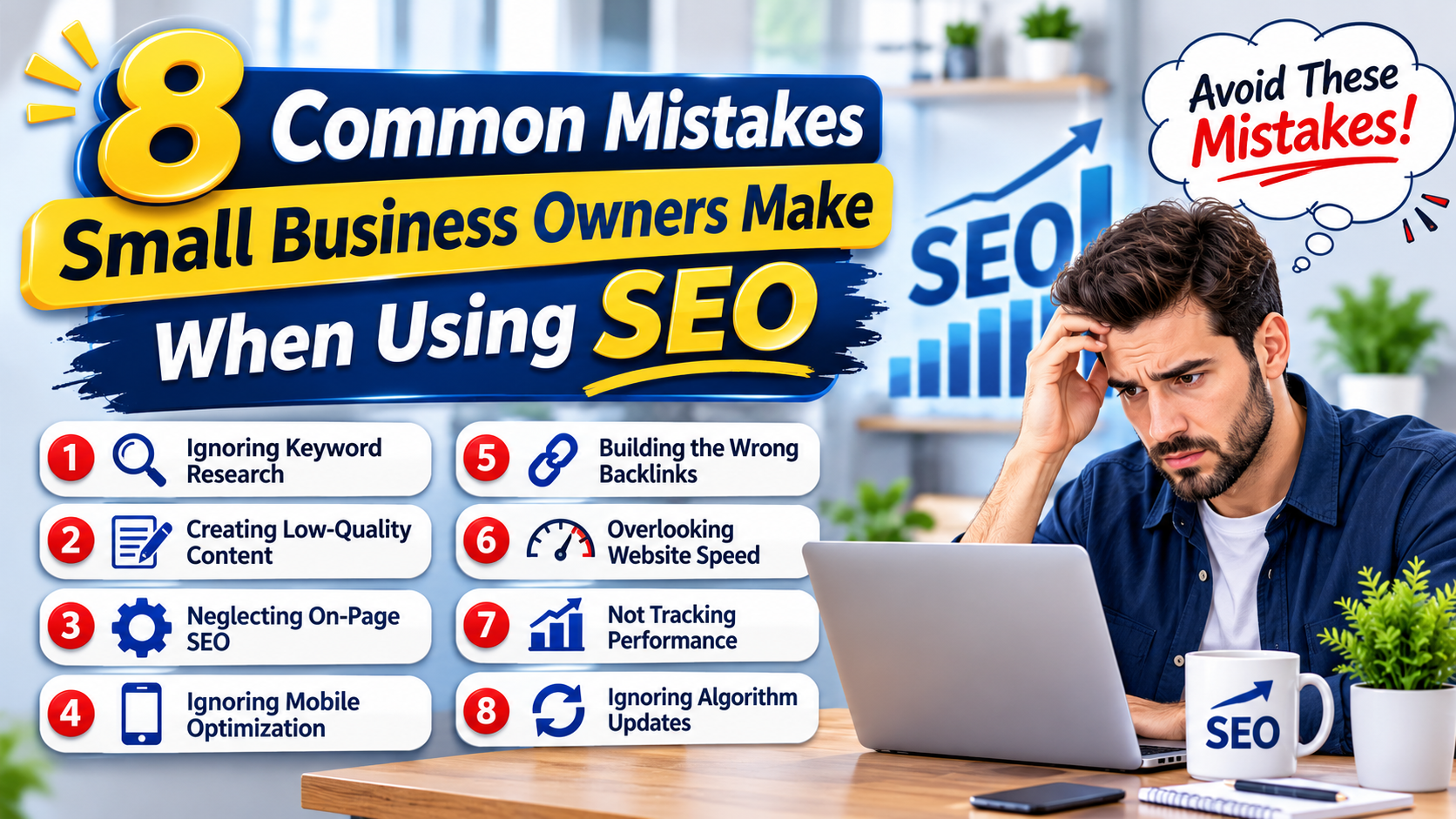
What Are the SEO Mistakes a Small Business Should Avoid?
A small business loses most of its reach in search to eight repeatable mistakes: a neglected Google Business Profile, wrong keywords, traffic without conversions, weak link building, ignored reviews, no tracking, skipped technical details, and no plan for AI search. Every one of them can be corrected, and most need effort rather than a large budget.
Think of your profile as a storefront window on Google: a map pin, a rating, and a phone number show up before anyone opens your site. Behind that window sits organic search, the free, steady stream of visitors that SEO exists to earn. A newer layer called AEO decides whether AI Overviews and chatbot answers mention you at all.
I arranged the sections below differently from most checklists, starting with local visibility and finishing with sequencing. Treat my opinions as practitioner observation and every number as a sourced fact.
Is Your Google Business Profile Quietly Costing You Local Customers?
A neglected Google Business Profile costs a small business local customers, because searchers often see that profile before they ever reach the website.
The profile’s link is where most owners slip. When it points to a generic page instead of a dedicated page for the service, the visit ends in missed conversions. Research from Backlinko (December 2025) lists a dedicated page for each service among the biggest local ranking factors, so I send profile visitors to matching service pages rather than a homepage.
Page-level details back that link up. Mark the destination with LocalBusiness schema, write a precise meta description, and keep a Redirection Manager or similar tool watching for detours. A quick audit every quarter catches breakage before customers do.
Local trust finishes the job. Ask each happy client for positive reviews, reply to every one, and consider joining your chamber of commerce, whose listing ties your business to the community.
Are You Targeting the Wrong Keywords for Your Small Business?
A small business targets the wrong keywords when it picks phrases that sound right to the owner instead of the words its ideal customers actually type into Google.
Place the right words where Google reads first: in the page headline, in descriptive image names, and in alt tags. Keep titles and snippets inside the character limits that the SEO Preview tool displays, so nothing is cut off mid-phrase.
Your business listing follows the same logic. Choose a primary category that mirrors your main phrase, then add supporting categories only where they are true. On BoFu pages, the bottom-of-the-funnel pages aimed at people ready to buy, precise wording matters more than volume.
Questions have changed too. People now put full questions to ChatGPT, Perplexity, or Claude, so natural phrasing travels further than clipped fragments.
Why Isn’t More Website Traffic Turning Into Customers?
Website traffic fails to turn into customers when the landing page gives visitors no clear reason to act, and sending more people there only repeats the failure.
Clarity fixes more than volume. A page titled 24/7 plumber in New York tells visitors and Google exactly what is offered and where, which beats clever wording that leaves people guessing.
Visitors also need somewhere to go next. Internal links invite them deeper and pass link equity around the site, while a visible trust signal reassures them. Only 4% of consumers say they never read reviews before choosing a business, according to BrightLocal in 2025.
The source of visits is shifting as well. Pew Research reported in July 2025 that 18% of Google searches triggered an AI summary, and users followed a link on 8% of visits with a summary versus 15% without one. Check what people do afterward in Google Analytics 4, then fix the page before chasing more organic traffic.
Do Links Actually Matter for a Small Business?
Links matter for a small business mainly when they connect your own pages and a few genuinely local sources, not when they are collected in bulk.
Linking between your own pages is slow work by hand, a real time sink for anyone publishing weekly blog posts, yet it is the cheapest authority you can build. Add a button or a contextual link to the next logical page so each visit becomes a longer one.
Outside links work differently. Local connections, meaning neighbors, suppliers, and community groups that really know you, give a link meaning, while paid or random links from sites with no tie to your town rarely do.
Treat linking as ongoing, not one-time: a few earned links each quarter beat a burst that then stops. Skip any approach that promises dozens of links overnight.
How Much Do Online Reviews Affect Local SEO?
Online reviews directly affect local SEO: BrightLocal’s 2025 research found that how complete and current a profile is makes up 32% of what decides map results, and reviews add another 20%.
Reviews also build credibility with people, not only search engines. Written feedback supplies proof that generic claims cannot, from concrete results to before-and-afters, and star ratings can even appear as rich snippets beside your listing.
Treat the Q&A area as part of that evidence. Owner answers there shape user trust the same way reviews do, and a blank section is a missed chance to answer objections before a call.
Expect the effect to build slowly. A first wave of reviews can land within weeks, but the compounding gains usually take three to six months.
Why Should a Small Business Track Its SEO Results?
A small business should track SEO results because without measurement, every decision becomes a guess, and many owners quit just before their efforts start paying off.
Start with the cheapest signal: tag the profile link with a UTM so analytics can separate local visitors, including those arriving from Google Maps. Then watch the conversion rate. Across most industries, about 2.9% of visitors take action, so a figure far below that points to the page, not the traffic, as the problem.
Give yourself a benchmark from your own history first, and keep a steady rhythm instead of refreshing numbers daily. When you publish, IndexNow can notify Bing and Yandex at once, which shortens the wait for new pages to appear.
Use the Rich Results Test to confirm that structured data on your pages is still valid, and replace any outdated markup. Hiring a done-for-you service is optional; measuring is not.
Which Technical SEO Details Do Small Businesses Skip?
Small businesses skip technical details such as consistent NAP data, crawl instructions, and measurement setup, even though those quiet faults drag rankings down without any warning.
Keep your name, address, and phone number identical across directories, because one wrong digit can keep you out of the local pack. On a site built with WordPress, a plugin such as AIOSEO offers a Robots.txt editor that controls which folders crawlers can reach, so you never hand-write code.
Then measure what people do. Pages that drive visitors away show up in bounce rate and time on page, while CTR shows whether a listing earns the visit. The free Google Search Console reports how your site appears in search, and a solid habit of checking it catches indexing problems early. Design every page for the human reader first.
| Tool | What it shows | Best used to |
|---|---|---|
| Google Search Console | How your site appears in search and whether pages are indexed | Confirm Google can find and crawl your pages |
| Google Analytics 4 | What people do after they land on your site | Spot pages that lose visitors |
Why Isn’t My Business Showing Up in AI Search Answers?
A business stays invisible in AI search answers when its pages do not state clear, credible answers to the exact questions customers ask.
Performing well in classic search results and being quoted by an AI tool are related but separate achievements. Your impressions can look healthy while clicks thin out, because an AI answer sits above the listings and satisfies the question first.
Write the way a plumber answers a call: if someone asks what to do about a burst pipe, give the steps first and the sales pitch second. Format matters less than directness, so quizzes and podcasts help only when they carry plain answers, and a plagiarised or hollow page gives an AI tool nothing worth quoting.
One agency’s guide notes that almost none of a small business’s competitors are thinking about this yet. Winning position zero, the featured snippet at the top, builds the same answer-first habit.
Should a Small Business Use an SEO Plugin?
Yes, a small business with a plugin-friendly site should use an SEO plugin, because it covers the basics that a one-person team cannot watch every day.
Owners already wear many hats, and a plugin takes several off. It can set 301 redirects and clear 404 errors so crawlers stop hitting dead ends, and it speeds up repetitive checks.
Typical features include a schema markup generator, automatic sitemaps, a Link Assistant that suggests on-site links, and a Search Statistics dashboard. No plugin will earn you a backlink, though, so keep expectations realistic.
Setup is where the quick wins appear, and most of it costs nothing but time.
How Do Stale Pages and Impatience Hurt Small Business SEO?
Stale pages and impatience hurt small business SEO because Google rewards sites that keep improving, while owners who expect instant results change too much at once and learn nothing.
SEO is not like an ad bill that buys visibility the same day; it pays back slowly. Spend 15 minutes once a month on small updates: new photos, accurate opening hours, a clean slug, and one useful page aimed at a clear search intent.
Keep the writing natural. Pages that avoid keyword stuffing and favor long-tail phrases read better and surface for niche searches. Guest posts and forums can seed relevance, but only on topics you genuinely know.
Stay active and measure against a realistic target: typical visitor-to-lead rates for local service businesses hover between 3-4%, per NiceJob. A site that goes dormant risks lower rankings as the market moves on.
Does the Order You Do SEO Tasks In Really Matter?
Yes, order matters because every fixable mistake builds on another, and the right move made too early or too late can waste a month.
A workable sequence looks like this:
- Complete your Google Business Profile and service pages.
- Build up reviews and publish useful pages.
- Move on to AI search, also called answer engine optimization.
Many owners jump to off-page SEO first. One agency founder reports paying about $300 for a link whose host site later vanished, leaving a toxic entry to clean up. Random tactics also leave you flying blind about which action actually worked.
The pattern behind it is the old 80% of results that come from about 20% of the work: do the few high-value moves first, in order.
What Is the Biggest SEO Mistake Small Businesses Make?
According to Anchora, the biggest SEO mistake is doing the work in the wrong order, treating it like an errand list instead of laying foundations first. A predictable order protects momentum, and the small stuff can wait until the core pages and profile are done.
Is SEO Worth It for a Small Business on a Limited Budget?
Yes, SEO is worth it on a limited budget because most high-impact fixes demand effort more than money. AIOSEO says its plugin is trusted by over 3 million site owners, which makes a DIY approach realistic, and basic measurement supports data-driven decisions. Paid help can speed things up but is not required to begin, so total cost stays largely in your control.
What Is the 80/20 Rule in SEO?
The 80/20 rule in SEO says roughly four-fifths of your results come from about a fifth of the work. Spend your energy on the highest-impact fixes first, the way a few key lifts do most of the work in exercise. Smaller tasks can wait.
What Are the 3 C’s of SEO?
The 3 C’s of SEO are the written material you publish, the technical build behind it, and the trust you earn from others. Each layer supports the next, and following best practices in all three keeps a small site steady. A weak layer drags the others down, so no single one can carry the site alone.
How Long Does It Take to Fix SEO Mistakes and See Results?
Fixing SEO mistakes pays back on two clocks: small listing fixes show early, while larger gains build slowly. Review progress every couple of weeks rather than daily, because Google’s algorithms need room to judge new pages. Practice patience and change one thing at a time, so you can tell what worked.
Why Is Audience Research Important for SEO?
Audience research matters for SEO because it shows which words real searchers use, so pages aim at people instead of guesses. Build audience personas from demographics and habits, and drop phrases that are irrelevant or overly competitive for your size. One therapist using grief therapy discovered that grief counseling drew about three times as many searches, and matching the audience’s own wording proved helpful.
What Happens If a Small Business Uses the Wrong Keywords?
A site using the wrong keywords appears for phrases that bring the wrong visitors, or none at all. Do keyword research before writing, and tailor it to the problems your customers describe and the needs behind them. Free tools like Google Ads Keyword Planner and Ubersuggest are enough to start. Revisit the list whenever your services change.
How Does Stale Content Affect SEO?
Stale content hurts SEO because search engines prefer pages that stay useful, and visitors abandon anything that looks obsolete. A site that goes quiet loses engagement, and low traffic follows. Replace thin content with substantive updates and publish fresh content on a steady schedule.
Why Is Mobile Optimization Necessary for SEO?
Mobile optimization is necessary because a large portion of users browse on mobile devices, and Google follows a mobile-first approach. About 30% of mobile searches relate to a location, and Think with Google reports that 74% of visitors to a mobile-friendly site are more likely to return. Responsive design lets one site adapt across screens, while a lean image format and fast loading speed protect user experience. Sites that do this are favored by search engines, which lifts search visibility.