
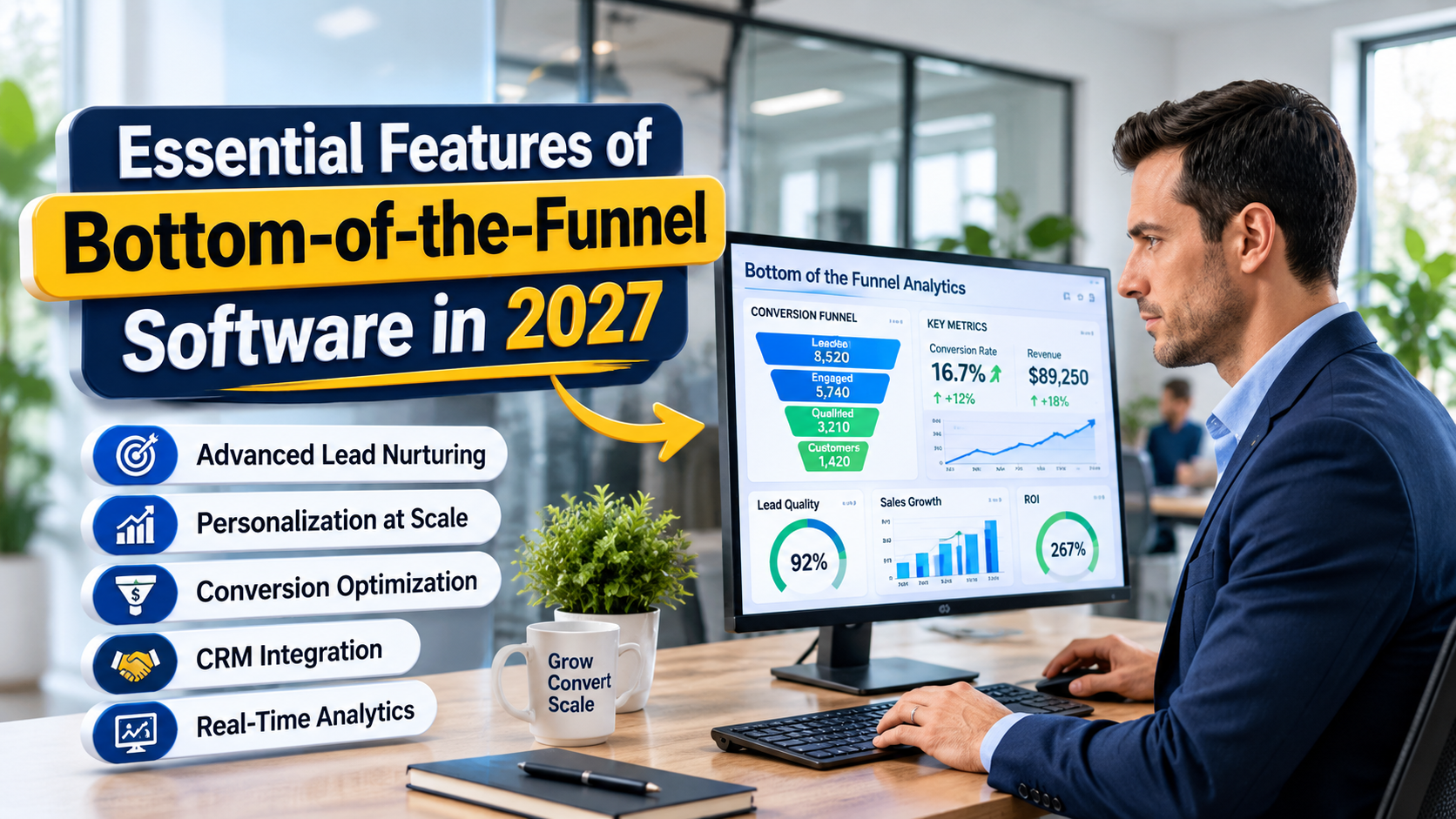
Essential Features of Bottom-of-the-Funnel Software in 2027

What Is Bottom of the Funnel Software?
Bottom of the funnel software is the toolset a business uses to turn people who have already picked its product into paying customers, covering offers, cart steps, email messages and measurement at the moment of decision.
This final stage of the sales process is small but valuable. The warmest visitors have already walked the whole customer journey, and what they want is proof that buying now is safe. Funnel.io reports that only 14% of marketing professionals prepare content for this stage, while 50% produce top-of-funnel material.
The software behind it usually combines dashboards that show where visitors stall, a CRM that keeps each contact’s history, and integrations that pass data between ads, pages and payment tools. In ecommerce, teams judge that stack by conversion rate and average order value.
Longer sales add a twist: Mixpanel notes that stakeholders may enter late and need material they can forward. In both cases, a clear lower funnel plan starts with reading intent, such as a cart left open or a product viewed twice, before any tool is chosen.
What Does Bottom-of-Funnel Software Actually Do?
Bottom-of-funnel software guides people who are close to buying through the last purchase steps and measures what happens along the way. BOFU stands for bottom of funnel, the decision stage where a lead picks a vendor. Demand generation builds awareness high in the upper funnel, while lead generation captures contact details from people further along.
The working parts are practical. A drag-and-drop editor builds offer pages, personalization tailors messages, automation removes repetitive tasks, and predictive analytics flag stalled deals, according to Salesforce.
Context shapes what you need. A brand new store may only need pages and cart tools, while a company decades old can use the same software to sort qualifying leads and see which are ready for outreach.
Who Needs It, and When Is the Right Time to Start?
Any business that sells online benefits, and so does any sales-led company, once its leads outgrow manual tracking. Zendesk says there is no hard-and-fast rule for when to commit, while Salesforce warns that manual management becomes unsustainable as a business grows.
The idea itself is old. Elias St. Elmo Lewis introduced the AIDA model in 1898, ending with a step called Action, and today’s software is a smarter version of that inverted triangle. The same work applies at every size: helping a ready lead finish the purchase.
Practical triggers vary. Teams often start when tracking turns into guesswork about where leads drop off, when a competitor wins deals you expected to close, or when a growing contact list size hits the limits of spreadsheets. Sales representatives then spend time updating records instead of selling.
Timing also depends on the customer. In B2C, decisions can happen much faster; longer sales can run months, and higher product complexity stretches them further, according to Funnel.io.
Which Features Matter Most Before a Customer Pays?
The features that matter most are the ones that remove friction between interest and payment, and AI now heads that list. Salesforce cites an AI writing-assistant tool that could lift conversions to its paid tiers by 80% through lead scoring, and a Semrush survey cited by Funnel.io found 55% of consumers use AI tools for product research.
Record-keeping comes next. Salesforce Sales Cloud keeps contacts and deals in one place, and having data centralized gives each message the right context. ActiveCampaign sends email, SMS and WhatsApp messages triggered by visitor behavior, and classic drip campaigns do the same on a schedule.
Checkout is where revenue lands. Checkout pages with a one-click upsell or downsell present another offer right after purchase, and product recommendations based on past purchases suggest the next item.
Which Kinds of Funnel Software Should You Compare?
Bottom-of-funnel software falls into five types, and the right choice depends on how much of the funnel one account should cover.
| Type | What it handles | Best fit |
|---|---|---|
| Lead capture tools | Forms, pop-ups and pages that collect contacts | Teams filling the top of the list |
| Email platforms | Behavior-based messages and audience groups | Nurturing known contacts |
| Contact-tracking systems | People, deals and sales stages | Teams that manage deals |
| Page optimizers | Building and testing pages | Improving existing pages |
| All-in-one builders | Pages, email, payments and delivery in one account | Sellers who want a single system |
A page optimizer manages a single web page at a time, whereas a sales funnel builder guides the customer across the whole buying experience. Salesforce notes that one popular page product leans on third-party tools for advanced workflows, and on the enterprise side it positions Agentforce agents for lead management.
One 2026 roundup shows a free plan on two tools, one of which also sells a $17/month tier billed monthly; several others are billed annually, and the analytics vendor sells Growth, Pro and Enterprise tiers. The all-in-one type suits sellers of courses and memberships, so choose by industry and sales model.
How Do Bottom-of-Funnel Tactics Turn Ready Visitors into Orders?
The tactics that work give a ready visitor one clear reason to buy now and then remove whatever blocks the purchase. Replo’s store examples show how this looks in practice.
Our Place launched the Always Pan with a waitlist that topped 60,000, then rebuilt its cart so checkout fell from over three pages to one, as a company executive told Shopify.
On the ad side, Oats Overnight puts 25% off a first box beside 120k+ reviews in one square, while Ursa Major lists tiers from 10% off two products to 20% off four or more, and the page its ad opens starts with the same line. That repetition quiets the last doubt.
Email and native ads follow the same logic. Starbucks sends a welcome email that promises insider offers, and Marc O’Polo reached a ROAS of up to 1500% using Outbrain’s native Smartad. In Funnel.io’s skincare example, a workshop attendee returned after a tailored recommendation email, completed a quiz and bought, and a product photo of the exact item viewed keeps that kind of message specific.
What Do Real Stores Do to Win Back a Cart?
A typical recovery series sends four messages over about a week and stops the moment the customer buys. The stores in Replo’s examples space them out and hold the incentive for the end.
| When | What to send |
|---|---|
| 1 hour | A reminder with an image of the item and a link back to the cart |
| 1 day | The top question about the item, answered, plus reviews |
| 3 days | Proof, such as a customer photo or star count |
| 5 to 7 days | A reason to act: free shipping, a gift with purchase or a small price cut |
Good reminder emails save the incentive for the last message, so customers who would have bought anyway do not learn to wait for one. Many real cart emails skip the coupon entirely, and the reason to act can also be a restock date.
On the cart itself, Replo recommends one big payment button with Apple Pay or Shop Pay where possible. For pricier items, product demos, live or pre-recorded, can answer the questions a 1 day message would otherwise carry.
Which Metrics and Reports Show the Funnel Is Working?
The metrics that show a bottom-of-funnel setup is working are the ones tied to orders and revenue, read alongside reports that show where visitors drop away. Funnel.io reports that brands applying a full-funnel strategy achieve 45% higher ROI than brands focused on a single stage.
Salesforce adds that analytics tools track sales velocity and customer behavior, built-in forecasting guides resource decisions, and KPIs keep performance visible. Three reports then do most of the diagnostic work:
- Funnel reports show the exact step and percentage where visitors leave, and Kartra tracks page visits, opt-ins, email performance, checkout activity, sales and drop-off points.
- Heatmaps show what visitors tap and how far they scroll, which explains why a page loses people.
- A/B testing tells you whether a new offer or review block wins more orders.
A test can reverse intuition. Server Density used Wingify to compare per-unit pricing with a packaged plan starting at $99 per month; free sign-ups fell 24.96%, yet revenue rose 114%.
What Does Bottom of the Funnel Mean in Marketing?
Bottom of the funnel is the last marketing stage, where people who have chosen your product decide whether to buy now. In the three-stage model, TOFU gathers attention and MOFU nurtures interest, so the bottom stage inherits prospects who know the problem and want reassurance before paying.
Typical content at this stage includes retargeting ads for shoppers who left an abandoned cart, testimonials, and a rating placed beside the buy button. A discount is one incentive and scarcity is another; Mixpanel lists both among its persuasion tactics.
The group at this stage is the smallest, so the buyers here deserve narrow, specific messages, as Mixpanel advises. Past the sale, retention and advocacy take over, and Funnel.io treats them as what happens after the conversion stage.
How Does a Complete Funnel Platform Differ from a Page Tool or a Contact Manager?
A complete funnel platform covers every buying step, a page tool serves one page with one goal, and a contact manager tracks people through a sales cycle. Zendesk draws the first line: a page is built for one marketing goal, while a funnel platform guides the customer through the entire buying experience.
Leadpages is the page-tool example. It captures contact information through pages and pop-ups, then passes each lead to an email or contact system for lead nurturing. GetResponse reaches further, joining pages, emails, product sales and unfinished-order recovery in one flow, with cross-selling prompts based on past purchases. Deep segmentation usually lives in the platform, not the page tool.
A contact manager reports pipeline value, whereas a funnel platform leans on revenue attribution to tie sales back to pages and campaigns. One vendor FAQ suggests that businesses selling online start with a funnel platform, and that teams whose salespeople manage deals start with the contact manager.
Price the choice honestly. Transaction fees, per-seat charges and paid add-ons shape the total cost of ownership, and the frequency of use of something like mobile access shows whether a bigger plan is worth buying.
What Hidden Costs Should You Expect, and Can You Start for Free?
Beyond the monthly subscription, expect charges that grow with contacts, team members and extra features, and several platforms let you begin without paying. A trial is the safest way to learn what a tool really costs your team in time.
| Tool | G2 score | Trial |
|---|---|---|
| ClickFunnels | 4.6/5 (417 reviews) | 14-day |
| Systeme.io | 4.8/5 (751 reviews) | None listed |
| HubSpot | 4.4/5 (15,977 reviews) | 14-day |
The review sites Capterra and TrustRadius, like G2, use five-star systems, and Salesforce says every tool in its roundup carries at least four of five stars. Treat a free trial as part of your extensive research: read the vendor’s onboarding emails, test the editor, and watch whether team members adopt it. Reviewer satisfaction counts here, because those sites score tools on feedback, features and overall satisfaction.
Set a budget against customer acquisition cost, not the sticker price alone, because a cheap tool that slows the team can cost more than a pricier one that speeds it up.
Should Every Bottom-of-Funnel Ad Carry a Price Cut?
No, bottom-of-funnel ads do not always need a price cut, because what they need is a clear reason to act now, and that reason can take several forms. If every ad carries a price cut, customers learn to hold out for it.
Catalog ads show the exact product a visitor viewed, and limited-time offers add urgency by putting an end date on the incentive. Mixpanel describes the same idea as a final nudge, delivered with messaging matched to the lead. The ad should open a landing page that repeats the offer on its first screen.
Behavior can trigger outreach instead of a price cut: Mixpanel’s example is a lead who views a pricing page but does not purchase within 24 hours. Funnel.io adds that a higher price point prolongs the decision, so proof may matter more than a cut.
Rewards tied to loyalty programs and repeat purchases give a reason to act without lowering price, and they suit digital products as well as physical goods. Judge any offer by add-to-cart rate, cart abandonment rate, checkout completion and return on ad spend.
How Long Does It Take Leads to Move Through the Funnel?
The time leads need to move through a funnel varies with the type of business, the price and how complicated the product is, so no single timeline applies. Funnel.io adds that consumer decisions can happen quickly, while B2B processes stretch out because people research widely and involve more decision-makers.
That is why sales cycle length is a bottom-of-funnel metric in Funnel.io’s list. By the time a lead speaks to sales, customers often hold strong opinions and a shortlist of options.
Salesforce names SaaS, real estate and consulting among fields that commonly use funnels, and each moves at its own pace. Pairing funnel work with content marketing keeps leads informed while they wait; Zendesk also advises reading each vendor’s terms to confirm data stays protected if the platform crashes.
The clock does not stop at purchase. After-purchase strategies such as customer education content and an exclusive community webinar invite customers back, aiming for brand evangelists who feed an organic cycle of new customers, or at least a second helping because the first exceeded expectations.
What Happens After the Bottom of the Funnel?
After the bottom of the funnel, a business shifts to keeping and growing the customer relationship, because the funnel does not stop at conversion, according to Funnel.io.
Follow-up carries that relationship: email sequences tied to purchases keep customers informed, and a returning customer is the clearest proof the funnel worked. Offers can seed the next order as well. Replo lists bundles, quantity breaks and subscribe and save as ways to raise order value before checkout, and the same structures can anchor a second purchase from an online store. A customer on a starter tier may later upgrade.
Measurement keeps the long view honest. Customer lifetime value counts purchases and referrals across the relationship, cost per acquisition shows what each new customer cost, and return on investment compares the spend with what comes back. Marketing mix modelling can quantify the incremental impact of channels across the whole funnel.
Research-led nurturing deserves a place too: Funnel.io cites studies that it can guide 50% more sales-ready leads, with 47% of those becoming customers who make larger purchases.